 how-to
How to Maintain a Tankless Water Heater: 2026 Guide
Table of Contents
- Why Tankless Water Heater Maintenance Matters
- Signs Your Tankless Water Heater Needs Maintenance
- Tools and Supplies for Tankless Water Heater Maintenance
- How Often to Flush a Tankless Water Heater
- Step-by-Step Tankless Water Heater Flushing Process
- Choosing a Tankless Water Heater Flushing Kit
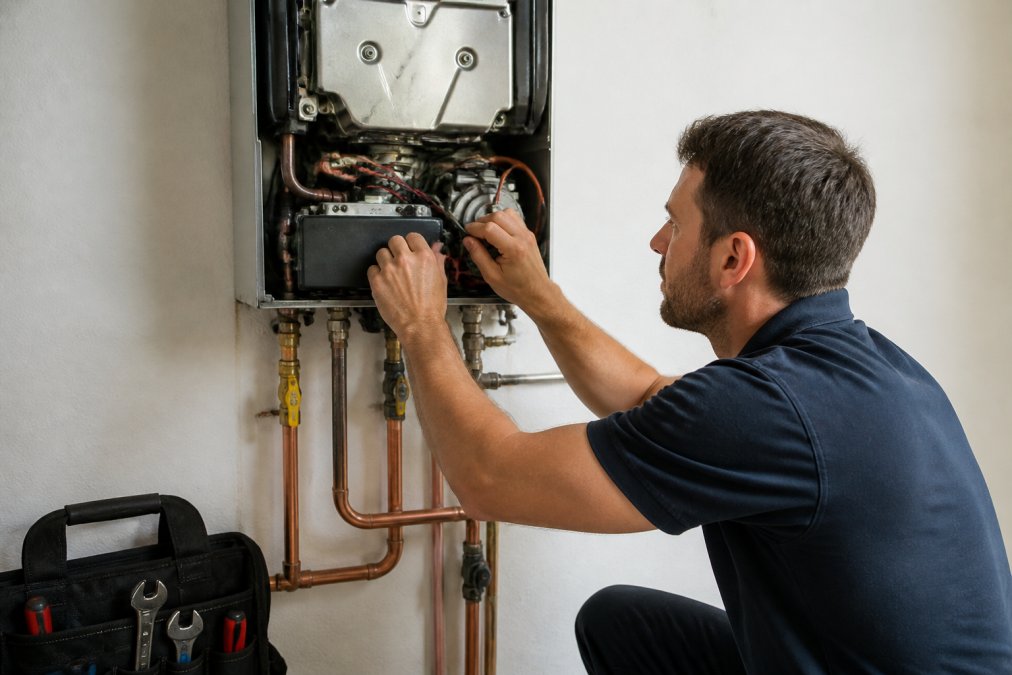
- When to Call a Professional for Tankless Water Heater Service
- Conclusion
- Frequently Asked Questions
Last Updated: September 16, 2026
Why Tankless Water Heater Maintenance Matters
Scale is the enemy of every tankless water heater. According to the U.S. Geological Survey's water hardness overview, hard water is common across large parts of the country, and the dissolved calcium and magnesium it carries settle out as mineral deposits when water heats inside the unit. Those deposits coat the heat exchanger, restrict flow, and eventually trigger error codes or a cold shower.
Signs Your Tankless Water Heater Needs Maintenance
The clearest sign your tankless water heater needs maintenance is inconsistent hot water: it arrives, then fades mid-shower, or the temperature swings without you touching the tap. Most manufacturers tie warranty compliance to annual servicing, so ignoring these signals can cost coverage as well as comfort.
Watch for these indicators:
- Fluctuating water temperature at the tap
- Reduced flow rate compared with when the unit was new
- Error codes on the digital display, especially flow or combustion faults
- Rumbling, popping, or banging sounds during heating cycles
- Visible scale or white crust around fittings and the inlet water filter
- Rust-colored water or corrosion on gaskets and hoses
Tools and Supplies for Tankless Water Heater Maintenance
You need a flushing kit, two short hoses, a submersible circulating pump, a bucket, and a descaling solution. A tankless water heater flushing kit bundles the pump, hoses, and fittings, saving you from hunting down mismatched adapters.
Gather these supplies before you start:
- Flushing kit with pump and hoses
- White vinegar solution or a commercial descaling agent
- Two buckets (one for the solution, one for rinse water)
- Adjustable wrench and screwdriver
- Soft brush for the inlet water filter
- Towels and gloves
How Often to Flush a Tankless Water Heater
| Water Hardness | Flush Interval | What Is Happening Inside the Unit |
|---|---|---|
| Under 1 GPG (soft) | Every 12 months | Minimal mineral deposition; annual flush is preventive |
| 1-3.5 GPG (slightly hard) | Every 12 months | Slow scale film forms but stays soft |
| 3.5-7 GPG (moderately hard) | Every 8-10 months | Visible scale on the heat exchanger by month 10 |
| 7-10.5 GPG (hard) | Every 6 months | Scale hardens and restricts flow within a year |
| Above 10.5 GPG (very hard) | Every 4-6 months | Rapid fouling; consider a whole-home softener |
| Private well (any reading) | Every 6 months, tested | Mineral content shifts with rainfall and season |
A few practical notes that change the math:
- High daily use shortens the interval. A household running two showers, a dishwasher, and a laundry load daily pushes more water through the heat exchanger than a single occupant, so scale accumulates faster at the same GPG.
- A whole-home water softener resets the clock. If your softener is working, treat your supply as soft water regardless of the raw source reading. Test the softened water, not the well or city intake.
- Well water needs seasonal testing. Snowmelt, drought, and aquifer changes can move hardness by several GPG within a year, so a reading from last spring may not describe this winter.
- Incoming water temperature matters. Colder groundwater makes the unit fire harder and longer to reach the setpoint, which accelerates deposition on the heat exchanger.
If you are unsure where your water falls, a hardness test strip or a call to your municipal provider settles it quickly. The goal is not to flush on a fixed calendar; it is to flush before scale hardens, and hardness in GPG tells you when that is.
Step-by-Step Tankless Water Heater Flushing Process
The flushing process takes about 45 to 60 minutes for most units and requires no special license, only patience and a clean workspace. Here is the sequence, plus the verification steps most guides skip.
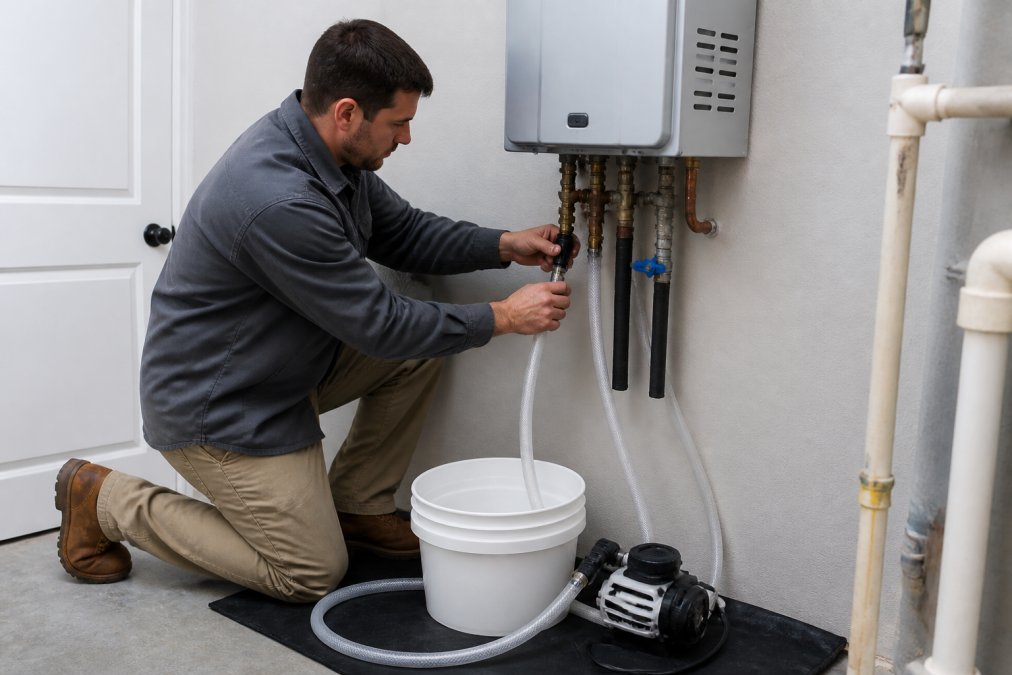
- Shut off the water supply. Close the water supply shut-off valve feeding the unit.
- Cut the power. Switch off the breaker for electric units, or turn the gas valve to the off position for gas models.
- Close the isolation valves. Shut both the hot and cold isolation valves so solution stays inside the unit.
- Open the purge ports. Remove the caps on the service valves and attach the flushing hoses.
- Connect the pump. Place the circulating pump in the bucket of descaling solution and connect the return hose.
- Circulate for 30-45 minutes. Let the solution move through the heat exchanger in a loop. If the solution turns dark or cloudy within the first 10 minutes, that is loosened scale, not a problem.
- Flush with clean water. Swap the pump into a bucket of fresh water and circulate for 5 minutes. Do not skip this; residual acid left in the heat exchanger will attack the metal over time.
- Restore and test. Close the purge ports, reopen the isolation valves, restore power, and run hot water.
Post-Flush Verification: Did It Actually Work?
Most guides stop at "run hot water and you're done." That is not a test. Here is how to confirm the flush worked and catch problems before they become service calls.
Troubleshooting After the Flush
| Symptom After Flush | Likely Cause | What to Do |
|---|---|---|
| Error code returns within a day | Scale still bonded to heat exchanger, or a failed sensor | Run a second descaling cycle with a stronger commercial agent; if the code persists, call a technician |
| Hot water starts strong, fades in 30 seconds | Flow sensor or inlet filter partially clogged | Remove and clean or replace the inlet filter; check the flow sensor for debris |
| Temperature never reaches setpoint | Burner not firing fully, or gas supply issue | Confirm the gas valve is fully open; if the flame is yellow or lazy, stop and call a professional |
| Water leaks at the purge ports | Cross-threaded or loose cap | Shut off the unit, reseat the cap with a new gasket, and retest |
| Rumbling or popping during heating | Air trapped in the lines, or remaining scale | Open a hot tap for several minutes to purge air; if noise continues, repeat the flush |
Expected Result: Steady hot water at the tap with no temperature swings or error codes after the unit restarts, a temperature rise within about 10°F of the unit's rated spec, and a flow rate at the tap that matches your baseline.
Choosing a Tankless Water Heater Flushing Kit
Buy a kit with a pump rated for at least 3 to 5 gallons per minute and hoses that match your unit's purge port size. Flow rate matters more than brand: a weak pump leaves scale in the far corners of the heat exchanger.
Check these before you buy:
- Pump flow rate of 3-5 GPM minimum
- Hose fittings that match your service valve threads
- Chemical-resistant hoses that tolerate vinegar and descaling agents
- A pump rated for continuous circulation, not intermittent use
When to Call a Professional for Tankless Water Heater Service
Call a professional when you see error codes that persist after flushing, signs of gas leaks, or any issue with the venting system or combustion chamber. Gas-side work is not a homeowner job, and venting must meet code for the unit to run safely.
Reach out to a licensed technician if you notice:
- Persistent error codes after a completed flush
- A yellow or unsteady flame instead of a clean blue one
- Any gas smell near the unit or its supply line
- Water leaking from the heat exchanger or internal fittings
- A failed pressure relief valve test
Conclusion
Maintaining a tankless water heater comes down to consistency: flush on schedule for your water hardness, clean the inlet water filter, and inspect the heat exchanger, burners, and flame sensor in the same visit. Miss those steps and you trade a simple annual task for an expensive repair.
Frequently Asked Questions
What is the most common problem with tankless water heaters?
Scale buildup is the most common issue. Minerals like calcium and magnesium in hard water accumulate inside the heat exchanger, reducing flow rate and thermal efficiency. Over time, this causes error codes, inconsistent hot water, and can lead to premature system failure. Regular flushing with a vinegar solution removes mineral deposits and keeps the unit running efficiently. In areas with hard water, more frequent maintenance is needed to prevent scale from hardening inside the unit.
Can I flush my tankless water heater myself?
Yes, many homeowners flush their tankless water heater using a tankless water heater flushing kit. The process involves shutting off the water supply, connecting hoses to the isolation valves, and circulating a vinegar solution through the heat exchanger for about 45 minutes. However, if you are uncomfortable working with water lines or if your unit has error codes or leaks, call a licensed plumber. DIY flushing is safe when you follow the manufacturer's instructions and use the correct kit.
What happens if you don't flush a tankless water heater?
Skipping regular flushing allows scale buildup to harden inside the heat exchanger. This reduces water flow, lowers performance efficiency, and can cause the unit to overheat or shut down. In severe cases, the heat exchanger cracks, leading to costly repairs or replacement. Sediment and mineral deposits also void warranty compliance if the manufacturer requires documented maintenance. Flushing every 12 to 18 months prevents these issues and extends system longevity.
How often should I maintain my tankless water heater?
The manufacturer typically recommends flushing every 12 months. If your water supply has high water hardness, flush every 6 to 8 months. You should also clean the inlet water filter every few months and inspect the venting system annually. Signs your tankless water heater needs maintenance include reduced hot water flow, strange noises, or error codes. Following a consistent maintenance schedule protects your investment and keeps your unit running efficiently.