 how-to
Preventing Emergency Plumbing Repairs in Commercial Facilities
Quick Summary
Preventing emergency plumbing repairs in commercial facilities comes down to inspecting systems on a written checklist, scheduling maintenance by risk, detecting leaks early, and keeping a clear emergency response plan. Most commercial plumbing emergencies build slowly over months or years, so catching aging pipes, stuck valves, and clogged drains early keeps repairs small and inexpensive.
- Use a written inspection checklist so routine checks do not depend on memory.
- Schedule high-risk systems like kitchen grease lines more frequently than low-risk fixtures.
- Test shutoff valves regularly so staff can stop water flow during a leak.
- Deploy leak detection such as point sensors, flow monitoring, or automated shutoff valves.
- Write an emergency plan that names who shuts off water and includes after-hours contacts.
Table of Contents
- Why Emergency Plumbing Failures Happen in Commercial Buildings
- Step 1: Build a Commercial Plumbing Inspection Checklist
- Step 2: Set a Risk-Based Commercial Plumbing Maintenance Calendar
- Step 3: Deploy Commercial Plumbing Leak Detection
- Step 4: Prioritize Assets and Document Performance
- Step 5: Write a Commercial Plumbing Emergency Response Plan
- Booking Your Next Plumbing Inspection with Colby Plumbing Company LLC
- Frequently Asked Questions
Why Emergency Plumbing Failures Happen in Commercial Buildings
Most commercial plumbing emergencies are not sudden. Learn the warning signs of a main sewer line clog before backups reach your building.
Across commercial buildings, the same patterns tend to repeat. The most common causes are aging pipes, neglected shutoff valves, and drains that were never cleaned on schedule. Each one turns a small fix into an expensive, disruptive repair.
Here is what usually goes wrong:
- Aging supply lines crack or corrode, especially in buildings more than 30 years old.
- Unmaintained shutoff valves seize up, so staff cannot stop water flow during a leak.
- Grease and debris build up in drains and kitchen lines, leading to backups.
- Freezing exposure bursts pipes in unheated areas during cold snaps.
- Undetected slow leaks cause hidden water damage long before anyone sees a drip.
The common thread is delay. A slow drip gets ignored, a valve goes untested, and a pipe nobody inspects keeps aging. Preventive maintenance works because it catches these problems while they are still cheap to fix.
The real cost of an emergency is rarely just the repair bill. Business downtime, damaged inventory, tenant complaints, and after-hours service calls add up quickly. Emergency service often carries a premium, so catching issues early can help limit costs.
Step 1: Build a Commercial Plumbing Inspection Checklist
A written inspection checklist is the foundation of any prevention plan. Use this emergency plumbing maintenance checklist to see which items belong on your recurring inspections. Without one, inspections depend on memory, and important items get skipped.
Start by listing every plumbing system in the building. Include supply lines, drains, water heaters, backflow devices, fixtures, and any grease traps. Then, for each system, note what to check and how often.
A practical checklist should cover:
- Visible pipes for corrosion, drips, staining, or loose fittings.
- Shutoff valves to confirm they open and close fully.
- Water pressure readings compared against your normal baseline.
- Drains for slow flow, odors, or gurgling sounds.
- Insulation on exposed pipes in unheated spaces.
- Water heaters for leaks, rust, and temperature settings.
Keep the checklist short enough to finish in a single walkthrough. A list that takes four hours will get skipped. Most facilities do well with a focused monthly walkthrough plus a deeper annual inspection.
Document every finding with a date, location, and photo when possible. This record becomes your baseline, and it helps you spot trends, like a valve that fails a little more each quarter.
Step 2: Set a Risk-Based Commercial Plumbing Maintenance Calendar
Not every system needs the same attention.
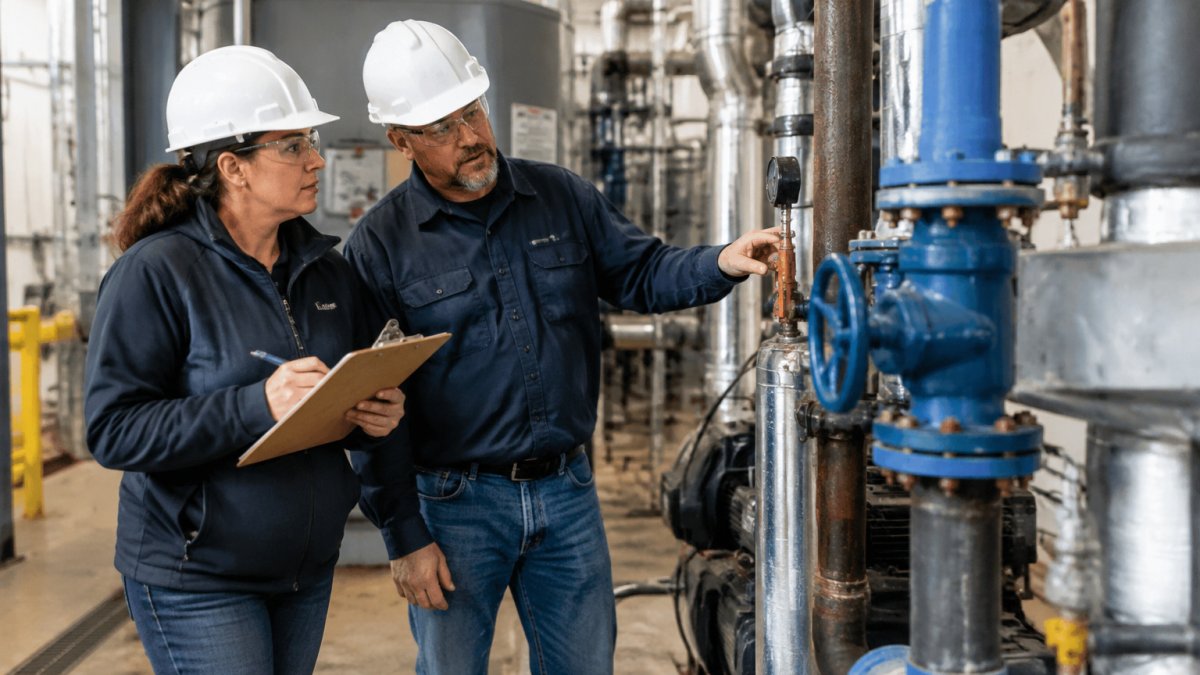
Facility type drives the calendar. See the main cost factors for commercial maintenance contracts before you commit to a recurring schedule.
A practical way to structure it is by cadence, then by facility type.
Daily and weekly tasks (on-site staff):
- Walk high-risk areas such as kitchens, restrooms, and mechanical rooms for visible drips, standing water, or staining.
- Check floor drains for odors or slow drainage, which signal a developing clog.
- Confirm grease traps are not overflowing and that kitchen staff are not pouring fats down drains.
- Log any water meter reading taken during unoccupied hours so unusual overnight use is caught early.
Monthly tasks:
- Inspect kitchen grease lines and schedule cleaning before buildup restricts flow.
- Test shutoff valves in high-risk zones to confirm they open and close fully.
- Check exposed pipe insulation in unheated spaces for gaps or damage.
- Review water pressure readings against the building baseline.
Quarterly tasks:
- Function-test shutoff valves across medium-risk zones.
- Inspect water heaters for leaks, rust, and correct temperature settings.
- Clean drain lines in restrooms and break rooms before slow flow becomes a backup.
Annual tasks:
- Test backflow prevention devices as your local requirements specify.
- Perform a deeper inspection of supply lines, water heaters, and aging components.
- Review the full asset inventory and flag systems due for replacement rather than another repair.
Facility type shifts the emphasis. A restaurant should treat grease lines and grease traps as its highest-frequency items, with monthly inspection and quarterly cleaning.
Schedule the work before winter and before peak seasons. Pre-winter inspections are especially valuable, since frozen pipes cause some of the most expensive commercial damage.
Good intervals also depend on your building's age and past problems.
Watch out: A calendar that exists only on paper does nothing.
The article lays out the maintenance calendar by cadence, so here is a quick view of which tasks fall at each interval.
| Cadence | Task | Who handles it |
|---|---|---|
| Daily and weekly | Walk high-risk areas for drips or standing water | On-site staff |
| Daily and weekly | Check floor drains for odors or slow drainage | On-site staff |
| Monthly | Inspect kitchen grease lines before buildup restricts flow | Facility team |
| Monthly | Test shutoff valves in high-risk zones | Facility team |
| Quarterly | Function-test shutoff valves across medium-risk zones | Facility team |
| Quarterly | Inspect water heaters for leaks, rust, and temperature | Facility team |
| Annual | Test backflow prevention devices | Licensed plumber |
| Annual | Review asset inventory and flag systems due for replacement | Facility team |
Step 3: Deploy Commercial Plumbing Leak Detection
Leaks are the most dangerous early warning sign because they often stay hidden. Water can soak into walls, floors, and ceilings for weeks before anyone notices. Read what happens if a leak goes unrepaired to understand the damage that builds up over that time.
Start with simple, low-cost methods. Regular visual checks, moisture readings in suspicious areas, and monitoring your water meter can reveal problems early.
For larger facilities, the choice comes down to three categories:
- Point moisture sensors are placed under sinks, behind water heaters, near supply lines, and in mechanical rooms. They are inexpensive and easy to deploy, and they alert you when water is present at a specific location. Their limitation is coverage: they only catch leaks where a sensor sits, so they work best in known high-risk spots rather than as building-wide protection.
- Flow monitoring watches water use across the whole system and flags unusual patterns, such as continuous flow during unoccupied hours. It can catch hidden leaks that no sensor would see, including slab leaks and slow supply-line failures. Its limitation is interpretation: normal operations like irrigation or ice machines can look like anomalies, so the system needs a baseline and some tuning to avoid false alerts.
- Automated shutoff valves close the water supply when a leak is detected, protecting the building even when no one is on site. They are the strongest protection against major water damage, but they depend on a reliable detection signal and can shut off water during a false alarm. Pair them with flow monitoring or sensors rather than relying on the valve alone.
Match the tool to your risk. Sensors near high-risk areas deliver the most value per dollar. Flow monitoring suits larger buildings where hidden leaks are hard to spot.
When choosing technology, ask three questions. What failure am I most worried about, and where would it start? Will the tool catch that failure, or only a subset of it? And who receives the alert, and will they act on it?
Test your leak detection system on a set schedule so you know it works before a real emergency. Replace sensor batteries, confirm alerts reach the right contact, and review false-alarm patterns to tune the system.
Watch out: Automated shutoff valves and flow monitors can trigger on normal operations such as irrigation or equipment cycling. Establish a baseline and confirm the shutoff logic before relying on automation to protect an occupied building.
Step 4: Prioritize Assets and Document Performance
Not every plumbing asset is equally important. Asset prioritization ranks each system by its criticality, meaning how much disruption and damage a failure would cause. This helps you spend time and money where it matters most.
Create a simple asset inventory that lists each system, its age, its last service date, and its criticality. Rank items as high, medium, or low. A main supply line that serves the whole building belongs at the top, while a rarely used break-room faucet sits lower.
Tracking performance over time shows whether your program is working. Useful metrics include:
- Number of emergency calls per quarter compared with the prior year.
- Average response time to plumbing issues.
- Repeat failures on the same system.
- Completed inspections versus scheduled inspections.
- Repair costs broken down by system.
Review these numbers quarterly. If emergency calls drop after you add leak sensors, you have proof the investment paid off. If repeat failures continue on one system, it may need replacement rather than another patch.
Step 5: Write a Commercial Plumbing Emergency Response Plan
Even the best prevention program cannot eliminate every emergency. A written emergency response plan makes sure your team knows what to do when a pipe bursts at 2 a.m. Without one, minutes are lost to confusion, and water damage spreads.
Your plan should answer a few key questions. Who has authority to shut off water? Where are the main shutoff valves? Who do you call first, and what is their after-hours number? How will you notify tenants or staff?
A practical emergency plan includes:
- Shutoff locations for the main supply and individual zones, clearly marked on a floor plan.
- Contact list with after-hours numbers for your plumbing service provider.
- Escalation steps for when the first contact does not respond.
- Occupant communication templates for notifying staff or tenants.
- Post-incident review steps to find the root cause and update your checklist.
Test the plan at least once a year. Walk through a mock shutoff drill so staff know exactly where valves are and how to operate them. Reliable after-hours response is an important part of limiting damage. Read what to expect from after-hours plumbing service before you call.
Booking Your Next Plumbing Inspection with Colby Plumbing Company LLC
Preventing emergency plumbing repairs in commercial facilities comes down to consistent inspection, smart scheduling, early leak detection, and a clear response plan. Each step reduces the chance that a small problem becomes a costly emergency.
If you want help building or running this kind of program, contact Colby Plumbing Company LLC. Colby Plumbing Company LLC is a family-owned and operated business serving the Denver metro area since 1996. Contact us today to discuss your commercial plumbing needs, and visit our website for current pricing or a quote.
Last Updated: November 5, 2026
Frequently Asked Questions
How often should commercial plumbing systems be inspected?
Most commercial plumbing systems benefit from a visual inspection at least once a year, with more frequent checks for high-use facilities such as restaurants, healthcare buildings and multi-tenant properties. Backflow prevention assemblies typically require annual testing by a certified tester. Restrooms, kitchen lines and water heaters often warrant monthly or quarterly walkthroughs by facility staff, with any leaks, pressure changes or slow drains logged and reported to a licensed plumber promptly.
What are the most common plumbing emergencies in commercial facilities?
The most common commercial plumbing emergencies include burst or failed supply lines, leaking shutoff valves, backed-up drains and grease-related blockages, water heater failures, and frozen pipes during cold weather. Many of these problems begin as small leaks or slow drains that go unaddressed. Catching them early through routine inspection and monitoring reduces the chance of water damage, business interruption and expensive after-hours emergency service calls.
How can facility managers detect plumbing leaks early?
Facility managers can combine regular visual checks of ceilings, under sinks, and mechanical rooms with water meter readings taken at set intervals. A sudden rise in usage during off-hours often signals a hidden leak. Moisture sensors placed near water heaters, floor drains and supply lines can send alerts before damage spreads, and automated shutoff valves can limit water loss when a leak is detected.
What should a commercial plumbing emergency response plan include?
A solid plan lists the location of every main shutoff valve and fixture-level valve, names the staff authorized to shut water off, and provides contact details for a licensed plumber available around the clock. It should describe how to notify occupants, protect electrical equipment and documents, and log the incident for insurance and maintenance records. Reviewing and practicing the plan with staff at least once a year keeps it usable under pressure.