 how-to
Avoiding Hidden Plumbing Service Fees: A Homeowner's Guide
Table of Contents
- Why Hidden Plumbing Costs Happen
- Questions to Ask a Plumber Before Hiring
- Flat Rate vs. Hourly Plumbing Pricing: Which Protects You Better
- Understanding Service Fees and Trip Charges
- What to Expect: Average Plumbing Service Call Cost Breakdown
- Red Flags in Plumbing Estimates and Invoices
- How to Protect Yourself with Written Estimates and Warranty Coverage
- Conclusion
Last Updated: August 29, 2026
Why Hidden Plumbing Costs Happen
Homeowners often face unexpected bills after plumbing work is complete because the plumbing industry operates with multiple layers of fees that aren't always transparent upfront. Plumbing work involves several cost components: a service fee covers the dispatcher, vehicle, fuel, and overhead; a trip charge applies when work proves more complex than described; emergency rates apply outside business hours; and diagnostic fees cover problem identification before repair begins.
Many plumbing companies bundle these fees into estimates without breaking them down clearly. A homeowner hears "we'll fix your leak for $400" without realizing it includes a $75 service fee, $50 diagnostic charge, and $275 in labor and materials. When the actual repair takes longer or requires additional parts, the total climbs further. The real issue isn't that these costs are unreasonable, they're legitimate business expenses, but that they're presented as surprises rather than line items. At Colby Plumbing Company LLC, we believe transparency starts with explaining exactly what you're paying for before work begins.
Questions to Ask a Plumber Before Hiring
The conversation you have with a plumber before they arrive determines how many surprises you'll face later. Start by asking how they charge for the initial visit, some include a diagnostic fee in the final bill only if you hire them, others charge upfront regardless. Ask explicitly: "Is there a charge just for you to come out and assess the problem?"
Next, clarify their service fee structure and what it covers. Does it include travel time, fuel, and overhead? Is it waived if you proceed with repairs? Ask: "What is your service fee, and does it apply to the total repair cost if I hire you?"

Inquire about their hourly rate or flat-rate pricing structure. Hourly rates can escalate if work takes longer than expected; flat rates lock in the price but may be higher to account for uncertainty. Ask: "Do you charge hourly or provide flat-rate quotes? Can you give me an estimate of how long this repair typically takes?"
Ask about parts markup. Plumbers typically charge 20-50% above wholesale cost, which is standard practice and covers inventory and expertise. Ask: "What's your markup on parts, and can I provide my own materials if I source them myself?"
Request a written estimate before work begins that lists every charge: service fee, diagnostic fee, labor hours or flat rate, specific parts with costs, and any additional charges. Finally, ask about their warranty on labor and parts. A reputable plumber stands behind their work. Ask: "What's your warranty on labor and parts, and how long does it cover?"
Flat Rate vs. Hourly Plumbing Pricing: Which Protects You Better
The pricing model your plumber uses directly impacts your exposure to hidden plumbing service fees.
Flat-rate pricing means the plumber quotes a single price for the entire job. You know exactly what you'll pay before work begins. If the repair takes longer than expected, you don't pay extra. The downside is that flat rates tend to be higher than hourly rates because plumbers build in a buffer for uncertainty. Flat-rate pricing works best for common, predictable repairs like fixing a leaky faucet or unclogging a drain.
Hourly pricing charges you for actual time spent. If a repair is faster than expected, you pay less. The risk is uncertainty, a plumber might estimate "about two hours," but it could take three. Hourly pricing also creates an incentive for slower work since plumbers don't lose money if jobs take longer. Hourly pricing works best for diagnostic work and complex repairs where scope is genuinely unknown.
The protection strategy: Request flat-rate quotes whenever possible for routine repairs. For complex work, ask the plumber to break the job into phases with separate flat rates for diagnosis, repair, and any additional work discovered during diagnosis. This hybrid approach gives you cost control while accommodating genuine uncertainty.
Understanding Service Fees and Trip Charges
A service fee (sometimes called a service call fee or dispatch fee) covers the cost of sending a plumber to your home: dispatcher salary, vehicle maintenance, fuel, insurance, and travel time. A typical service fee ranges from $50 to $150 (bls.gov). This fee is legitimate, though it's sometimes applied differently, some plumbers charge it separately, others roll it into their labor rate, and some waive it if you hire them for the repair.
A trip charge applies when the plumber arrives and discovers the problem is more complex than described over the phone. For example, you call about a backing-up kitchen sink expecting simple drain cleaning, but the plumber discovers your main sewer line is damaged. A trip charge compensates for the time spent diagnosing a problem more involved than initially described. The key distinction: a service fee is always charged for the visit itself. A trip charge applies only when the actual problem differs significantly from what was described.
Emergency rates apply if you need service outside normal business hours. Emergency plumbing rates often run 1.5 to 2 times the normal rate. Call during business hours and ask: "What's your emergency rate if I need service after hours or on weekends?" A transparent plumber will tell you immediately.
What to Expect: Average Plumbing Service Call Cost Breakdown
Understanding typical cost components helps you evaluate whether an estimate is reasonable. A standard plumbing service call includes a service fee ($50 to $150), diagnostic time ($50 to $100, though many plumbers include this in their service fee or labor rate), and labor at $75 to $150 per hour depending on experience level (bls.gov).
Materials vary based on what's needed. A fill valve costs $15 to $40; a new faucet runs $50 to $300; a water heater replacement can exceed $1,500. Plumbers typically mark up parts 20-50% above wholesale cost, which is standard industry practice (phccweb.org).
For a straightforward repair like a leaky faucet, expect $150 to $300 total. For a more complex repair like fixing a broken water line under your house, expect $500 to $1,500 depending on accessibility. The best way to understand costs for your specific situation is to request an itemized estimate that breaks down each component separately.
Red Flags in Plumbing Estimates and Invoices
A vague estimate with a round number is a red flag. "I'll fix your leak for $500" tells you nothing. A legitimate estimate specifies service fee, diagnostic charge, labor rate or flat rate, parts with costs, and any additional charges.
Estimates significantly lower than competitors warrant scrutiny. If three plumbers quote $600 and one quotes $300, the low bidder either has lower overhead, is inexperienced, or plans to make up the difference with hidden charges later.
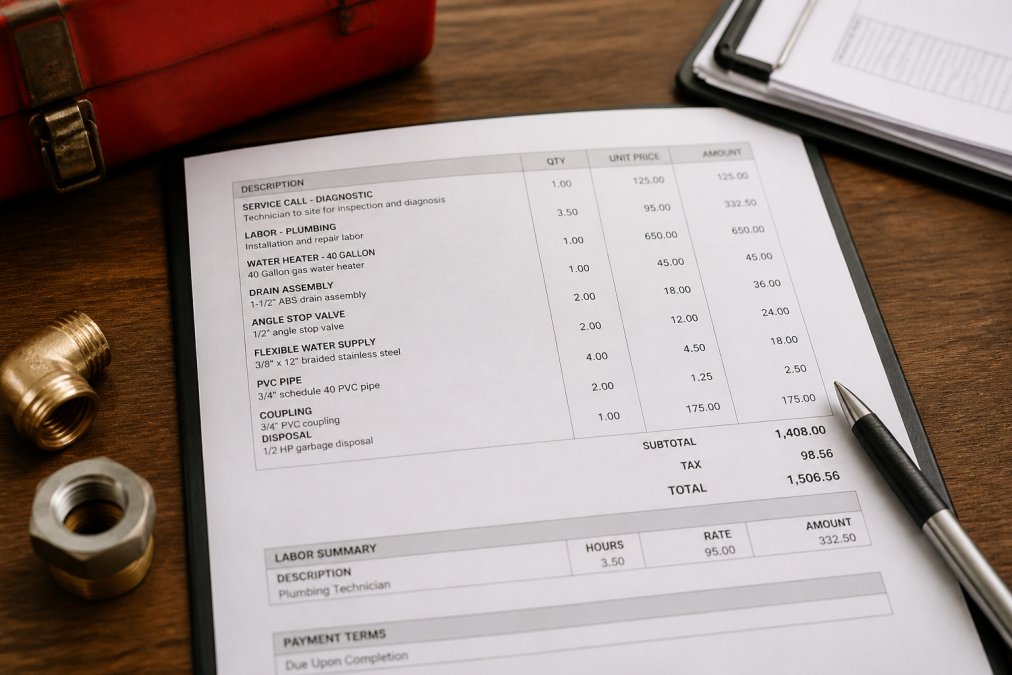
Refusal to provide a written estimate is a major red flag. A professional plumber documents their quote in writing. Vague invoice line items are problematic, an invoice that says "labor: $400" without specifying hours leaves room for disputes. A detailed invoice lists "labor: 3 hours at $100/hour for water heater repair."
Charges appearing on the invoice that weren't mentioned in the estimate signal trouble. If the estimate said $400 and the invoice is $600, there should be a clear explanation for the difference. A plumber who won't guarantee their work or offer any warranty is risky, if they won't stand behind their repair, why should you trust the quality?
How to Protect Yourself with Written Estimates and Warranty Coverage
Written estimates document what the plumber agreed to do and what it will cost. They prevent disagreements and create accountability. When requesting a written estimate, specify: service fee amount, diagnostic fee if applicable, labor rate or flat rate with estimated duration, list of specific parts with individual costs and markup percentage, any additional charges, warranty on labor and parts, and payment terms.
Before agreeing to proceed, confirm that any additional work discovered during the repair requires your approval and a revised estimate. Request a detailed invoice after work is complete and compare it line-by-line to the estimate. A legitimate difference might be "discovered additional damage to the pipe that required replacement" with a corresponding change order.
Warranty coverage protects you if the repair fails. A standard warranty is 30 days on labor and one year on parts, though some plumbers offer longer coverage. Understand what the warranty covers, the specific repair, the entire plumbing system, or damage caused by the repair? Document the warranty in writing on the invoice or a separate warranty certificate.
For major work like water heater replacement or re-piping, ask about extended warranties. Some plumbers offer five-year or longer warranties on labor for significant jobs.
Avoiding hidden plumbing service fees comes down to three practices: asking detailed questions before hiring, requesting itemized written estimates, and confirming warranty coverage. These steps take minimal time but eliminate nearly all billing surprises. When you work with a plumber who prioritizes transparency, one who breaks down costs clearly, documents everything in writing, and stands behind their work, you gain confidence that the final bill will match your expectations. Colby Plumbing Company LLC has served the Denver metro area since 1996 by making transparency central to every job. Our licensed professionals provide detailed written estimates, explain every charge upfront, and guarantee your satisfaction. Contact us today for a transparent estimate on your next plumbing project, and experience the difference that honest pricing makes.
Frequently Asked Questions
Is it normal for a plumber to charge a service fee or call-out fee?
Yes, most plumbers charge a service fee or trip charge to cover the cost of dispatching a technician to your home. This fee typically covers travel time, fuel, and initial assessment of the problem. However, many plumbers will credit this fee toward the total cost if you proceed with the work. Always ask upfront whether the service fee is refundable or applied to labor costs.
What questions should I ask before hiring a plumber to avoid hidden costs?
Ask about the service fee, whether it's refundable, the hourly rate or flat rate for the job, what's included in the estimate, warranty coverage on parts and labor, permit requirements, and any potential additional costs if complications arise. Request a written estimate that itemizes all labor, materials, and fees. Ask whether emergency or after-hours rates apply and get clarity on the scope of work before the plumber begins.
How can I tell if a plumber is overcharging me?
Compare written estimates from multiple licensed contractors to establish a baseline. Review your invoice for itemized charges, labor rates, parts markups, and fees should be clearly listed. Check that the labor hours match the actual work performed. Be wary of vague line items like 'miscellaneous' or 'additional labor' without explanation. Licensed contractors in good standing typically offer transparent pricing and are willing to justify their charges.
What's the difference between flat-rate and hourly billing for plumbing work?
Flat-rate pricing sets a fixed cost for a specific job, protecting you from overages if work takes longer than expected. Hourly billing charges based on actual time spent, which can lead to surprises if complications arise. Flat-rate pricing is often better for simple, well-defined jobs, while hourly rates may apply to complex diagnostics or emergency repairs where the scope is unclear. Always request a written estimate and ask which pricing model applies to your situation.
This article was written using GrandRanker