 how-to
Electric Water Heater No Hot Water: Troubleshoot & Fix
Table of Contents
- Safety Precautions Before Troubleshooting Your Electric Water Heater
- Check the Circuit Breaker and Power Supply
- Find and Reset the High-Temperature Limit Switch
- Electric Water Heater Reset Button Location and How to Use It
- How to Test Water Heater Element with Multimeter
- Inspect Thermostats and Check for Sediment Buildup
- When to Replace Electric Water Heater vs. Repair
- Conclusion
- Frequently Asked Questions
Last Updated: September 23, 2026
An electric water heater that produces no hot water can leave you frustrated, but electric water heater troubleshooting reveals many problems are fixable without a professional. This guide walks you through troubleshooting steps to identify the issue and determine whether you need a repair or replacement.
Safety Precautions Before Troubleshooting Your Electric Water Heater
Turn off power at the circuit breaker and wait at least 30 minutes for the tank to cool. Wear safety glasses to protect against falling sediment. Keep the work area dry and well-lit. If you smell gas or see water pooling around the base, stop and contact a licensed plumber immediately.
Check the Circuit Breaker and Power Supply
Check your electrical panel for the breaker labeled for your water heater. If it's in the "off" position, flip it to "on" and wait 10 minutes. If the breaker trips again immediately, there's an electrical problem inside the heater, do not keep resetting it. Check the power cord connection for corrosion, loose wires, or burn marks. If the connection looks clean, plug it back in or have a licensed electrician reconnect it if hardwired.
Find and Reset the High-Temperature Limit Switch
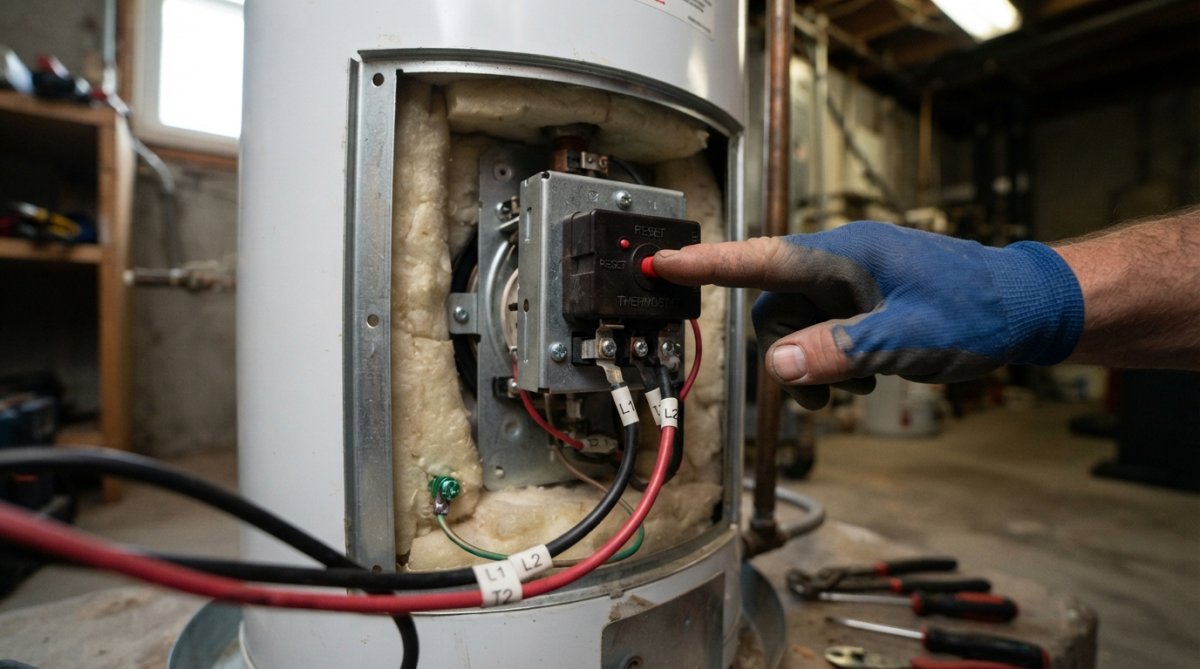
Every electric water heater has a high-temperature limit switch that shuts off power if water gets too hot. Turn off power at the circuit breaker, remove the access panel, and press the red or black reset button on the thermostat until you hear a click. Restore power and wait 30 minutes to test hot water. If the switch trips again within days, the thermostat is faulty and needs professional inspection.
Electric Water Heater Reset Button Location and How to Use It
The reset button for the high-temperature limit switch is the most important control on your heater. Finding it quickly can save you time and frustration.
The reset button is always located on the thermostat itself. On most tanks, the thermostat sits behind the lower access panel. You'll see a red or black button protruding from a metal or plastic housing.
To use it, turn off power first. Press the button straight in until you feel it click. The click confirms the switch has reset. Do not press multiple times or with excessive force.
Turn the power back on and wait 20 minutes for the tank to reheat. Test the hot water at a sink or shower. If hot water returns, the reset was successful.
If the button pops out again within hours, stop using it as a temporary fix. This pattern means something is overheating the tank. Call a professional to inspect the thermostat and heating element.
How to Test Water Heater Element with Multimeter
Testing the heating element with a multimeter is the most reliable way to confirm whether it's failed.
What a Multimeter Does and Why It Matters
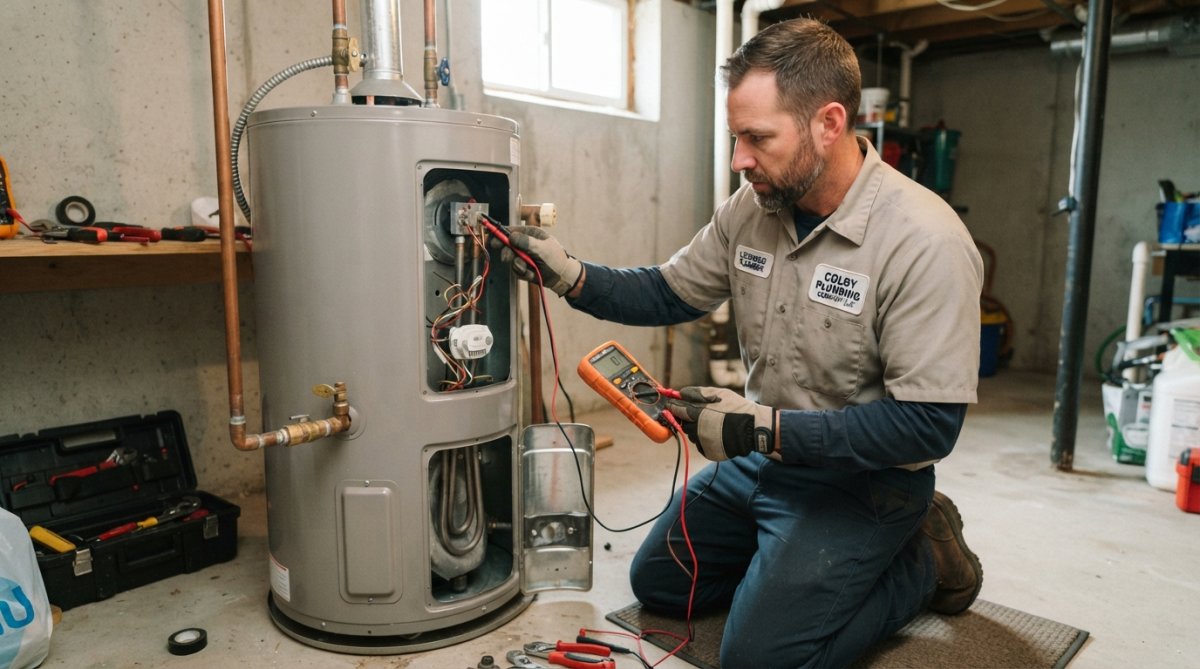
A multimeter measures electrical resistance in ohms (Ω). A functioning heating element reads 10-30 ohms. A reading of 0 ohms means the element has shorted; infinity ("OL") means it's broken. Either abnormal reading requires element replacement, there is no repair option.
Step-by-Step Multimeter Testing Process
Step 1: Turn Off Power and Wait
Flip the circuit breaker to off and wait 30 minutes for the tank to cool and discharge electrical current.
Step 2: Locate and Remove the Access Panel
Use a screwdriver to remove the lower access panel. Gently pull aside any insulation to expose the thermostat and heating element terminals.
Step 3: Photograph the Wire Connections
Take a photo of how wires attach to the heating element terminals before disconnecting anything, this is your reference for correct reconnection.
Step 4: Disconnect the Wires from the Element
Loosen the terminal screws and pull the wire connectors straight off.
Step 5: Set Your Multimeter to Ohms Mode
Step 6: Test the Heating Element
Step 7: Reconnect the Wires Correctly
Common Multimeter Mistakes to Avoid
Common mistakes: Touching both probes to the same terminal gives a false zero reading. Always test with power off. Skip the photo and you'll reconnect wires incorrectly. If your multimeter shows "OL" on 200Ω, try the 2000Ω range.
What to Do If the Element Tests Bad
If the element has failed, replacement is the only solution. Replacement elements cost $30-$100 and take 30-60 minutes to install. If the element tested good but water still won't heat, test the thermostat next.
Inspect Thermostats and Check for Sediment Buildup
Electric water heaters have two thermostats that work together to heat and maintain water temperature. Either can fail independently and produce different symptoms.
How the Two Thermostats Work
The upper thermostat signals the upper heating element to turn on when temperature drops. If it fails, no heating occurs. The lower thermostat maintains temperature via the lower element. If it fails, water heats initially then cools without reheating. Both are mounted behind access panels on the tank side.
Checking Thermostat Settings
Remove the access panels and check that both thermostats are set to the same temperature (standard is 120°F). If one is significantly lower, adjust it to match. If both are equal but water still won't heat, the thermostats may be faulty.
Testing a Thermostat for Failure
To test a thermostat, turn off power and wait 30 minutes. Remove the access panel and turn the dial to the highest temperature setting. Restore power and wait 5 minutes. If you hear a click or hum, the thermostat is working. If you hear nothing and the element doesn't heat after 30 minutes, the thermostat is faulty.
When to Replace a Thermostat
Thermostat replacement is necessary if:
- The thermostat dial is stuck and won't turn.
- The element does not heat even after you've adjusted the dial to the highest setting and waited 30 minutes.
- The high-temperature limit switch trips repeatedly within days, suggesting the thermostat is not controlling temperature correctly.
- You've tested the heating element with a multimeter and confirmed it's good, but no heating occurs.
Replacement thermostats cost $30-$75 each and take 15-30 minutes to install. You'll need to turn off power, drain the tank partially, disconnect the old thermostat, and install the new one in the same position.
Sediment Buildup and Tank Flushing
Sediment is a separate issue from thermostat failure, but it's a common cause of poor heating performance. Over time, minerals (calcium, magnesium) and rust particles settle at the bottom of the tank and coat the heating elements. This thick sediment layer insulates the element from the water, preventing efficient heat transfer.
Signs of sediment buildup include:
- Hot water takes much longer to arrive at faucets than it used to.
- The heater makes popping or rumbling sounds as sediment shifts inside the tank.
- Water coming from the drain valve is cloudy or brown.
- The heater works but produces only lukewarm water, not hot.
How to Flush Sediment from Your Tank
Flushing the tank removes sediment and restores heating efficiency. This process takes 30-60 minutes.
Step 1: Turn Off Power and Water Supply
Step 2: Attach a Drain Hose
Step 3: Open the Drain Valve
Step 4: Close the Drain Valve and Refill
Step 5: Restore Power
Flushing Frequency
Flush your water heater annually if you live in an area with hard water (high mineral content) (the EPA). In areas with soft water, flushing every 2-3 years is usually sufficient. Regular flushing prevents sediment from accumulating and extends the life of your heating elements and thermostats.
When to Replace Electric Water Heater vs. Repair
Deciding whether to repair or replace depends on the heater's age and the cost of the fix.
Conclusion
Electric water heater troubleshooting shows no hot water doesn't always mean a costly emergency. Start by checking your circuit breaker and resetting the high-temperature limit switch. Test the heating element with a multimeter to confirm it's working. Flush sediment from the tank annually to keep your heater efficient.
Frequently Asked Questions
Why does my electric water heater have no hot water?
No hot water typically stems from a tripped circuit breaker, a faulty heating element, a reset high-temperature limit switch, or sediment buildup inside the tank. Start by checking the circuit breaker in your electrical panel. If it's in the OFF or tripped position, switch it back ON. If it trips again immediately, you likely have a short circuit or failed element requiring professional service.
How do I reset my electric water heater?
Most electric water heaters have a red reset button on the high-temperature limit switch, located under the access panel on the side of the tank. Turn off power at the circuit breaker, remove the access panel cover, press the red button firmly until it clicks, then restore power. If the button pops out again within minutes, the thermostat or heating element may be faulty and needs replacement.
How do I know if my water heater element is bad?
A faulty heating element prevents water from reaching the desired temperature. To test it, turn off power at the circuit breaker, use a multimeter set to ohms (Ω), and touch the probes to the element terminals. A working element reads between 10-30 ohms. A reading of zero or infinity indicates the element has failed and requires replacement by a licensed plumber.
Is it worth fixing an electric water heater or replacing it?
If your heater is under 8 years old and the repair cost is less than 50% of a replacement unit, repair is usually worthwhile. Heaters older than 10-12 years or showing multiple failures (sediment, corroded dip tube, failed elements) are better replaced. A new unit offers better efficiency and a warranty. Contact a licensed plumber to assess whether your specific situation favors repair or replacement.