 how-to
How to Verify a Plumbing License: Step-by-Step
Table of Contents
- Why Verify a Plumbing License Before Hiring
- What Happens If You Hire an Unlicensed Plumber
- How to Verify a Plumbing License Online
- Understanding License Status Definitions
- Questions to Ask a Plumber Before Hiring
- How to Verify Plumbing Business Insurance
- Red Flags of Unlicensed or Uninsured Work
- Conclusion
Last Updated: August 13, 2026
Why Verify a Plumbing License Before Hiring
Hiring a plumber without verifying their credentials exposes you to unlicensed contractors, substandard work, and legal complications. A verify plumbing license check takes minutes but protects your home, your plumbing system, and your wallet.
When you hire a licensed plumber, you confirm they've met training requirements, passed exams, and carry necessary bonds and insurance. Licensed professionals are held accountable to regulatory standards. If something goes wrong, you have recourse through the licensing board. With an unlicensed contractor, you have almost none.
At Colby Plumbing Company LLC, we've worked in the Denver metro area since 1996 and seen the aftermath of unlicensed work: burst pipes installed incorrectly, code violations that fail inspections, and homeowners left holding expensive repair bills. Verification is your first line of defense.
What Happens If You Hire an Unlicensed Plumber
The consequences extend far beyond a bad repair job. You're exposing yourself to legal, financial, and safety risks.
Legal liability falls on you. If an unlicensed plumber damages your home or causes injury, your homeowner's insurance likely won't cover it. Insurance policies typically exclude coverage for work by unlicensed contractors. You're personally liable for medical bills, property damage, and legal fees.
Code violations create problems at resale. Plumbing work must meet local building codes. Unlicensed work often doesn't. Inspectors will flag violations when you sell. Buyers may demand expensive corrections or walk away entirely.
No warranty or recourse. Licensed plumbers carry bonds and insurance to protect customers. Unlicensed contractors don't. If a pipe fails two months after installation, the unlicensed plumber has no obligation to fix it. You pay out of pocket.
Safety hazards compound over time. Improper plumbing can lead to water damage, mold growth, or gas line issues. These problems often don't surface immediately, but damage becomes extensive and expensive.
How to Verify a Plumbing License Online
Verifying a plumbing license is straightforward. Every state maintains an online licensing database run by its plumbing board or regulatory agency.
Step 1: Find Your State's Licensing Board
Identify your state's plumbing regulatory agency, typically called the State Plumbing Board or Department of Licensing. Search for "[Your State] plumbing license verification" to find the official portal. Stick to official government sources, not third-party websites claiming to aggregate licensing information.
Look for a section labeled "License Lookup," "Verify a License," or "Search Licensed Contractors," typically in the main navigation or under "Public Records."
Step 2: Locate the Verification Portal
The verification portal is usually one or two clicks from the homepage. Most states provide a search function prominently displayed, allowing you to search by contractor name, license number, or business name. Some states also let you filter by city or county.
Before searching, note what information the portal requires. Some require exact name matches; others are more flexible. If searching for "John's Plumbing" returns no results, try variations like "John Plumbing" or "J Plumbing."
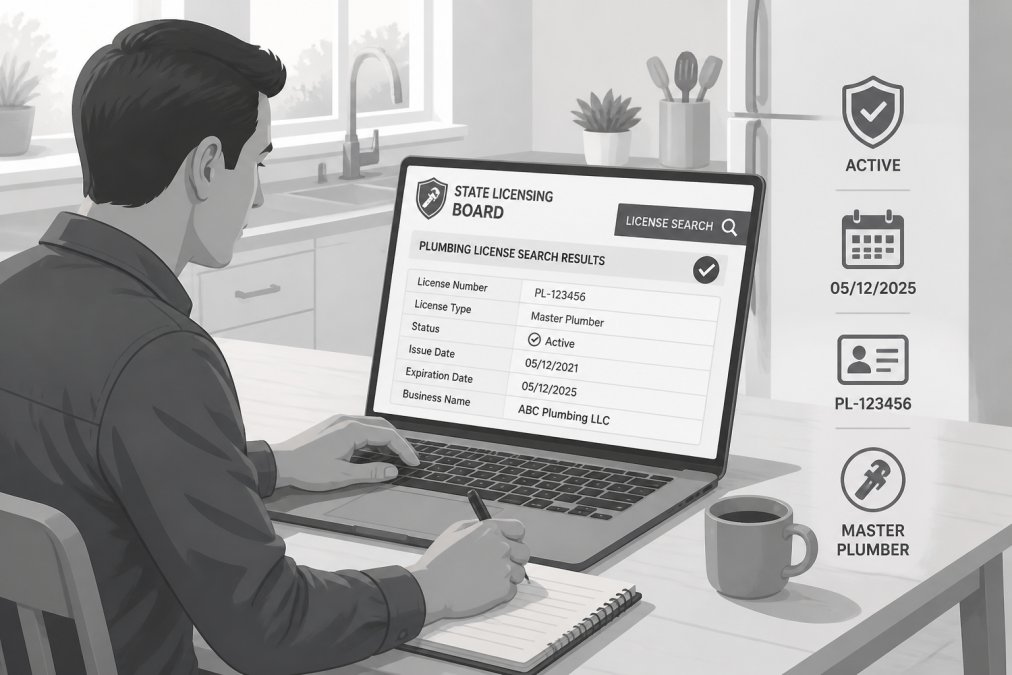
Step 3: Search Using Required Search Fields
Enter the plumber's information into the search fields. If you have the license number, use it, it's unique and eliminates ambiguity. When searching by name, enter the full legal name as it appears on the license.
Review the search results carefully, including license number, classification, current status, and business address.
Step 4: Review License Status and Classification
Examine the license status and classification carefully. The status field shows whether the license is active, expired, suspended, or revoked. You want to see "Active" or "Current."
The license classification indicates what type of plumbing work the contractor is authorized to perform. Classifications vary by state but typically include "Master Plumber," "Journeyman Plumber," or "Apprentice." Some states distinguish between residential and commercial licenses. Ensure the plumber's classification matches your project scope.
Pay attention to any disciplinary actions listed. A pattern of violations suggests a contractor who doesn't follow regulations consistently.
Understanding License Status Definitions
License status terminology varies by state. Here's what the most common statuses mean:
Active or Current means the license is valid and the contractor is authorized to perform plumbing work. This is what you're looking for.
Expired means the license was valid but the contractor failed to renew it. An expired license is not valid. The contractor cannot legally perform plumbing work.
Suspended indicates the licensing board has temporarily revoked the contractor's right to practice, usually due to violations, unpaid fines, or failure to meet continuing education requirements.
Revoked is permanent. The licensing board has permanently removed the contractor's license, usually due to serious violations or fraud. A revoked license cannot be reactivated.
Inactive or Retired means the contractor has voluntarily surrendered their license or placed it on inactive status. They are not currently authorized to perform plumbing work.
Questions to Ask a Plumber Before Hiring
Once you've confirmed a valid license, dig deeper with specific questions about experience, insurance, and approach.
Ask about experience with your specific type of work. A plumber experienced in new construction might not suit a bathroom remodel. Ask how many years they've done the specific work you need and request references from similar projects.
Confirm insurance and bonding. Ask to see proof of general liability insurance and workers' compensation insurance. A plumbing bond protects you if the contractor fails to complete work or violates building codes. If a plumber refuses to provide proof, that's a dealbreaker.
Ask how they handle unexpected issues. Plumbing projects often uncover surprises. Ask how they communicate when costs might exceed the estimate. Do they call for approval before proceeding? Do they provide written change orders?
Request a detailed, written estimate. A vague estimate is a red flag. Ask for a breakdown of labor, materials, and timeline. If they give a rough ballpark and say "we'll see," find someone else.
Ask about warranty or guarantee. What happens if the work fails within a certain period? Reputable plumbers often warranty their labor for a year or more.
How to Verify Plumbing Business Insurance
Confirming a valid license is only half the verification equation. You also need to confirm adequate insurance.
Ask to see the Certificate of Insurance directly. A legitimate plumber should provide a Certificate of Insurance (COI) without hesitation. This document lists the insurance carrier, policy numbers, coverage limits, and expiration date.
Check the coverage types. General liability insurance protects you if the plumber damages your property or causes injury. Workers' compensation insurance covers employees if injured on the job. Both are important; general liability is non-negotiable.
Verify the coverage amounts. For residential plumbing work, general liability limits of at least $1 million are standard. If limits seem low, ask why.
Confirm the insurance is current. Check the expiration date on the Certificate of Insurance. Ask when their policy renews.
Request the plumber add you as an "additional insured." This means you're protected under their policy if something goes wrong. Reputable plumbers often do this automatically for larger jobs.
Red Flags of Unlicensed or Uninsured Work
Certain warning signs indicate you're dealing with an unlicensed or uninsured contractor.
They refuse to provide a license number or business name. A licensed plumber should proudly share their license number and encourage verification. Evasiveness is a red flag.
They demand cash payment only. Unlicensed contractors often insist on cash to avoid a paper trail. Licensed professionals accept multiple payment methods and provide invoices.
They quote prices significantly lower than other estimates. If a plumber's estimate is dramatically lower, they're likely cutting corners on licensing, insurance, or materials. Savings upfront become expensive repairs later.
They have no physical business address or phone number. Legitimate plumbing businesses maintain offices and phone lines. Communication only via text or social media is suspicious.
They won't provide references or proof of past work. Ask for at least three references from recent jobs. A legitimate plumber should provide these readily.
They pressure you to start work immediately without a written estimate. Reputable plumbers take time to understand your project and provide written estimates. Pressure to start immediately suggests they're avoiding documentation.
They claim licensing doesn't matter or is just a formality. Licensing exists to protect consumers. A plumber who dismisses licensing requirements signals they don't take regulations or consumer protection seriously.
Verifying a plumbing license is one of the most important steps in protecting yourself as a homeowner. It takes minutes but prevents costly mistakes. Before hiring any plumber, use your state's licensing database to confirm credentials. Ask about insurance, experience, and warranties. Trust your instincts; if something feels off, move on. When you're ready to hire a professional you can trust, contact Colby Plumbing Company LLC to discuss your project. We've served the Denver metro area since 1996 with licensed professionals who stand behind every job. Our team is committed to transparency, fair pricing, and quality work your home deserves. Contact us today for a consultation on your next plumbing project.
Frequently Asked Questions
Why is it important to verify a plumbing license before hiring?
Verifying a plumbing license protects you from unlicensed contractors who lack proper training, bonding, and insurance. Licensed plumbers must meet regulatory requirements, maintain professional liability coverage, and comply with building codes. If unlicensed work fails or causes damage, you have no legal recourse. Checking license status and contractor credentials ensures you're hiring someone qualified to handle your project safely and correctly.
What should I do if I cannot find a plumber's license online?
If you cannot find a plumber's license through the online verification portal, contact your state's licensing board directly. Call the plumbing board or regulatory agency and provide the contractor's name, license number, or business entity information. Ask about their license status, any disciplinary actions, and renewal dates. If the board confirms no active license exists, do not hire that contractor. A legitimate plumber should have verifiable credentials.
What does an active license status mean versus expired?
An active license status means the plumber's professional license is current and valid, they meet all regulatory oversight requirements and continuing education obligations. An expired license means the plumber failed to renew on time and is no longer legally permitted to perform plumbing work. Never hire someone with an expired license. Always verify the license status shows active before signing any contract or allowing work to begin.
How do I verify a plumber's license in a different state?
Each state maintains its own licensing board and online database for professional licenses. Search for your specific state's plumbing board or regulatory agency website. Most states have a searchable online database where you can enter the contractor's name, license number, or business entity. Some states allow you to search by city or county. If you cannot locate the portal, call the state board directly for guidance on how to verify that tradesperson's credentials.
This article was written using GrandRanker