 ultimate-guide
Benefits of Installing a Water Pressure Booster Pump
Table of Contents
- Why Weak Water Pressure Is More Than an Annoyance
- Signs You Need a Water Pressure Booster Pump
- How Does a Water Booster Pump Work?
- Low Water Pressure Troubleshooting: Is a Booster Pump the Right Fix?
- The Benefits of Installing a Water Pressure Booster Pump
- Water Pressure Booster Pump Installation: What to Expect
- Cost, Maintenance, and Alternatives to a Booster Pump
- Conclusion
- Frequently Asked Questions
Last Updated: October 16, 2026
Why Weak Water Pressure Is More Than an Annoyance
Weak water pressure is a symptom of a system that cannot keep up with demand. At Colby Plumbing Company LLC, we have handled water pressure calls across the Denver metro area since 1996, and the pattern is almost always the same: the homeowner blames the showerhead, replaces it, and the problem stays exactly where it was.
A water pressure booster pump is installed on your home's water supply line and increases incoming pressure to a consistent, usable level. It does not create water, it adds force to water that is already there but arriving too slowly.
Here is what most guides get wrong: booster pumps are not a universal fix. Installing one when the real problem is a failing pressure regulator or a clogged line wastes money and solves nothing. The benefits of installing a water pressure booster pump are real, but only when the diagnosis is correct first.
Signs You Need a Water Pressure Booster Pump
The clearest sign you need a water pressure booster pump is pressure that drops whenever more than one fixture runs at once, a shower that weakens the moment a toilet flushes or a washing machine fills.
Other signals we see regularly:
- Water takes noticeably longer to fill a bathtub or a large pot than it used to
- Faucet flow at the kitchen sink is fine, but the upstairs bathroom is weak
- Appliances like dishwashers and washing machines take longer to complete a cycle
- Pressure fluctuates throughout the day, worse in the morning or evening
- Sprinklers or irrigation zones lose reach and coverage
If only one fixture is weak, the problem is usually local. If the whole house is weak at peak times, that points to the incoming supply.
How Does a Water Booster Pump Work?
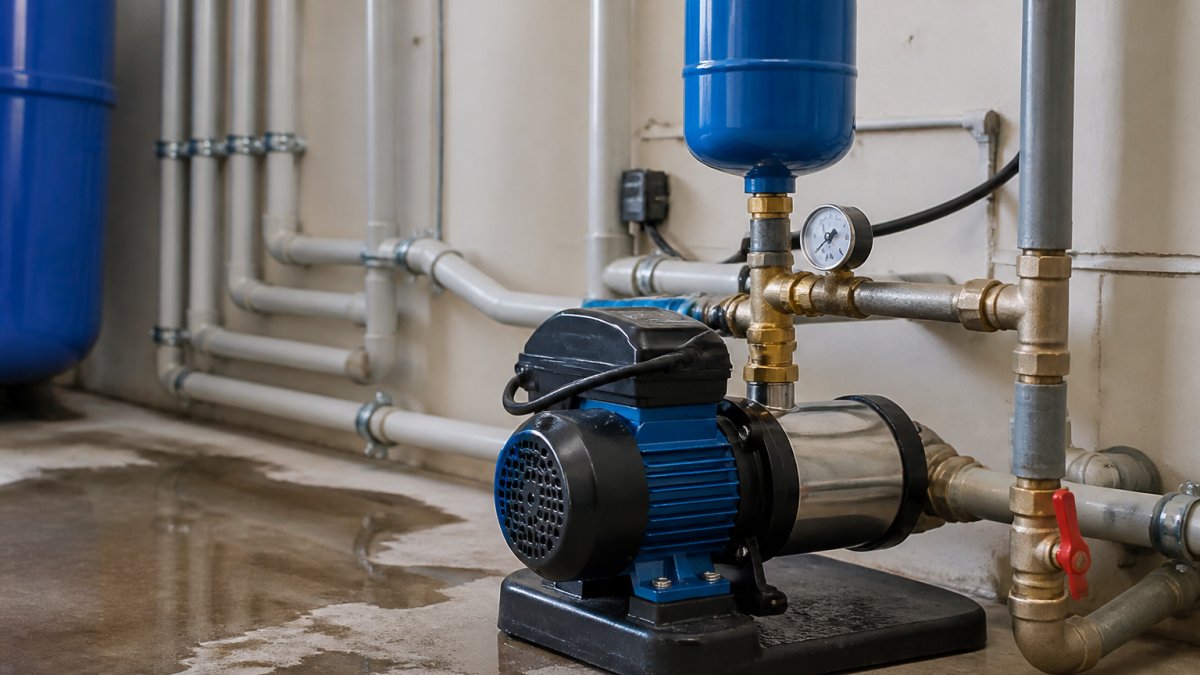
A water booster pump draws water from the incoming supply and pushes it forward at a higher, steadier pressure than the municipal line delivers on its own.
The components are straightforward:
- Inlet connection ties into the existing supply line
- Pump impeller adds force to the water as it passes through
- Pressure tank stores a small reserve to smooth out surges and prevent short cycling
- Pressure switch turns the pump on and off based on demand
- Low-water protection shuts the pump down if the supply runs dry, protecting the motor
On city water, the pump supplements whatever pressure the main provides; on well water, it works alongside the existing well pump and pressure tank. Either way, the goal is stable inlet pressure that does not collapse when demand spikes.
Low Water Pressure Troubleshooting: Is a Booster Pump the Right Fix?
Low water pressure troubleshooting starts with ruling out the cheap problems first.
Work through this in order:
- Test the pressure. Attach a gauge to a hose bib closest to where the main enters the house. Note the reading.
- Test at peak and off-peak times. Pressure that reads fine at 2 p.m. and drops at 7 a.m. points to a supply-side issue.
- Check the pressure reducing valve. Many homes have one, and they fail. A stuck or worn valve can choke the entire supply.
- Inspect for clogged aerators and cartridges. Sediment buildup restricts flow at individual fixtures.
- Look for a partially closed valve. A gate valve that is only half open will cut flow dramatically.
- Check for leaks. A hidden leak on the service line bleeds pressure before it ever reaches your fixtures.
If steps 1 through 6 come back clean and pressure is still low, a booster pump is a reasonable next step. If a failed regulator or leak is the cause, fix that first.
The Benefits of Installing a Water Pressure Booster Pump
The benefits of installing a water pressure booster pump come down to consistency: you stop planning your day around when the water works.
Shower performance improves immediately, strong, even flow unaffected by a toilet flushing in the next room.
Appliance performance improves because fill-cycle appliances run on a timer, low flow means the cycle starts before the tub is full.
Simultaneous fixtures stop fighting each other, two showers, a dishwasher, and a running hose can operate at once without one collapsing.
Every benefit traces back to one variable: stable inlet pressure.
Water Pressure Booster Pump Installation: What to Expect
Installation is a plumbing job, not a DIY project: cutting into the main supply line, mounting the pump, wiring it to power, and pressure-testing every connection. But the part that determines whether you are happy with the result happens before anyone picks up a wrench: sizing.
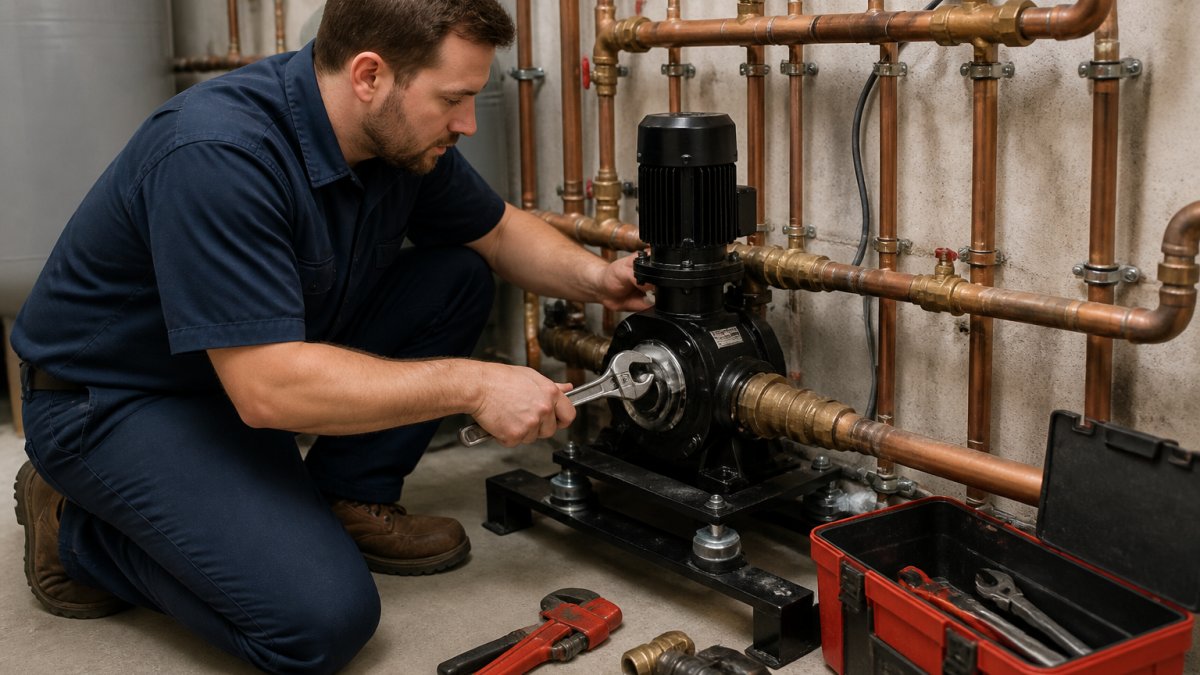
Sizing the pump before you buy it
A booster pump is selected against a pump curve, not a marketing spec sheet. The sizing process works like this:
- Measure static pressure. Attach a gauge to a hose bib near where the main enters the house with no fixtures running. This is your baseline supply pressure.
- Measure flowing pressure. Run a known fixture, a bathtub or a hose at full open, and read the gauge again. The drop between static and flowing tells you how much the supply sags under load.
- Measure flow rate. Fill a measured container and time it, or use a flow meter, to get gallons per minute at a representative fixture. This is the number that actually sizes the pump.
- Count simultaneous fixtures. A household that routinely runs two showers, a dishwasher, and a washing machine at once needs a pump sized for that combined demand, not for one fixture at a time.
- Account for elevation. Every foot of vertical rise between the pump and the highest fixture costs pressure. A pump that performs at the basement may underperform on a third-floor shower.
- Match the pump curve. The pump's published curve shows the flow it can deliver at a given boost. You want the curve to cover your required flow at your required pressure, not to exceed it wildly, which wastes energy and money.
An oversized pump short-cycles and wears out early; an undersized one runs continuously and never quite delivers. Both are avoidable with the measurements above.
Target pressure and safe limits
Most residential plumbing and fixtures are designed to operate well below the pressures that cause failures. A common target for household delivery is roughly 50-60 psi, aiming for the middle of that band rather than the top. Pushing beyond it raises the risk to supply lines, connections, and appliance valves without making showers meaningfully better.
Two safety devices matter here:
- Pressure-reducing valve (PRV). If incoming municipal pressure is high, a PRV brings it down to a safe household level. Adding a booster pump to a system with a failed PRV stacks pressure on top of pressure, so verify the PRV works first.
- Backflow prevention. A booster pump pressurizes the household side of the system, and without backflow protection that pressure can push household water back toward the supply. Requirements vary by jurisdiction, so check local rules.
Never install a booster pump without confirming current static pressure and the condition of any existing pressure-reducing valve. Adding boost to a system that is already over-pressurized risks burst connections and water damage, and it is one of the most common mistakes made when a pump is treated as a universal fix.
What the install itself involves
A typical install runs through these stages:
- Site assessment. Confirm incoming pressure, flow rate in gallons per minute, pipe sizing, and available space.
- Pump and tank selection. Match capacity to measured household demand, not to the largest unit available.
- Mounting. Secure the pump and pressure tank to a stable surface, with isolation valves on both sides and a bypass so the system can be serviced without shutting off the house.
- Plumbing connection. Tie into the supply line, usually with copper or PEX, and pressure-test every joint.
- Electrical. Connect to a dedicated circuit. Most residential booster pumps need a nearby outlet or a hardwired connection; a new circuit is a separate scope of work.
- Calibration. Set the pressure switch to your target range and confirm the pump cycles correctly under real load, not just at the kitchen sink.
Expect a partial-day job for a straightforward install; complicated layouts, tight utility rooms, or a new circuit will extend it.
Before you commit
Check local plumbing requirements for work on the main supply line and the pump's electrical connection; a pump installed without the required permit can complicate a future home sale or insurance claim. On a well system, the booster pump works alongside the existing well pump and pressure tank, and the sizing math changes, the well pump's output, not municipal pressure, becomes the limiting factor.
Cost, Maintenance, and Alternatives to a Booster Pump
Most benefit-focused pages stop at "a booster pump costs a few hundred to a couple thousand dollars", a useless range without knowing what drives it. Here is how the money actually breaks down.
What you are paying for
A residential booster pump typically costs a few hundred dollars for a small single-fixture unit and roughly $1,500-$2,500 for a larger whole-house system with an integrated pressure tank. The pump itself is rarely the largest line item once installation is included.
Installation cost is driven by four variables:
- Where the pump goes. A utility room with existing copper or PEX, a nearby drain, and open wall access is the cheap case. A finished basement, a slab, or a cramped crawlspace adds labor hours fast.
- Electrical. If there is already a dedicated circuit within a few feet, you pay for a connection. If a new circuit has to be run from the panel, that is a separate electrical line item and often the single biggest swing factor.
- Bypass and isolation valves. A proper install includes valves on both sides of the pump plus a bypass so the house can run on city pressure while the pump is serviced. Skipping these saves money up front and costs more later.
- Permits and inspection. Many jurisdictions require a plumbing permit for work on the main supply line, and some require an electrical permit for the pump circuit. Permit fees vary widely by jurisdiction and are usually modest, but the inspection step adds scheduling time.
A straightforward whole-house install is commonly a partial-day job; add a new circuit, finished-wall repair, or tight mechanical space and it can stretch to a full day or more.
Operating cost
A residential booster pump draws little electricity, it runs only on demand. The more meaningful ongoing costs are:
- Pressure tank charge. The tank's air charge slowly bleeds off. A tank that has lost its charge makes the pump short-cycle, which raises electricity use and shortens pump life. Checking and recharging it is inexpensive; ignoring it is not.
- Strainer or filter cleaning. If your supply carries sediment, the inlet strainer clogs and the pump works harder. Cleaning frequency depends entirely on your water.
- Pressure switch and fittings. These are the parts that fail first. They are inexpensive to replace, but only if they are caught before they cause the pump to run dry or cycle to death.
Expected lifespan and what actually kills a pump
A well-maintained residential booster pump commonly serves for many years, but lifespan is governed more by duty cycle and water quality than by brand. Three failure modes worth knowing:
- Short cycling from a failed pressure tank or a mis-set pressure switch. The pump starts and stops rapidly, overheats, and wears out early.
- Dry running when the supply is interrupted. Low-water protection exists specifically to prevent this; a pump without it is vulnerable to a single supply outage.
- Sediment and scale in the impeller, which reduces output gradually until the pump appears to have "stopped working" when it is really just fouled.
Noise and placement
A booster pump should run quietly, a low hum, not a grind or rattle. Grinding usually means a bearing or impeller problem; rattling means the pump or its piping is not isolated from the structure. Mounting on a stable surface with flexible connections and vibration isolation pads keeps noise out of living space, and if the only available location is next to a bedroom, that is a real design constraint.
Alternatives, and when each one wins
| Alternative | Best for | Trade-off |
|---|---|---|
| Replace a failing pressure-reducing valve | Whole-house low pressure traced to a bad PRV | Does nothing if the supply is genuinely weak |
| Replace a clogged filter or clear a blockage | Pressure loss that appeared suddenly or is localized | Only works if the restriction is the actual cause |
| Repair a service-line leak | Pressure that drops progressively over time | Requires locating and excavating or rerouting |
| Upsize the service line | Older homes with undersized supply piping | Invasive and expensive; may not be the root cause |
| Add or recharge a pressure tank | Surges and short cycling with adequate average pressure | Will not raise baseline pressure |
| Adjust or replace the well pump and pressure switch | Well systems with a failing pump or mis-set switch | Well-specific; does not apply to municipal supply |
| Booster pump | Consistently low or erratic supply pressure that survives diagnosis | Requires power, maintenance, and correct sizing |
The decision rule
Run the diagnosis first. If static pressure at the hose bib is low all day, the supply is the problem and a booster pump is the right spend. If static pressure is normal but flow collapses under load, you likely have a volume or piping problem, and a pump sized for pressure alone will disappoint you. If pressure is high and erratic, you may have a failing PRV, adding a pump on top of that over-pressurizes your plumbing.
Budget for the install, not just the pump. The pump is the predictable cost; electrical work, permits, and access are the variables. And spend the diagnosis time first, the most expensive outcome is a correctly installed pump on the wrong problem.
Conclusion
Weak water pressure is a diagnosis problem before it is a repair problem, and getting the diagnosis wrong costs you money either way. When the supply itself is the issue, a correctly sized booster pump restores consistent pressure to every fixture in the house.
Colby Plumbing Company LLC has served the Denver metro area since 1996 as a family-owned and operated business. Our licensed, seasoned professionals handle pressure testing, pump sizing, and full installation for both residential and commercial properties, backed by our 100% satisfaction guarantee and a track record of showing up when we say we will.
Get started with Colby Plumbing Company LLC and get your water pressure back to where it belongs. Contact us today for an assessment.
Frequently Asked Questions
What are the benefits of installing a water pressure booster pump?
A booster pump increases pressure for the whole home, restoring strong flow at showers and faucets, cutting the time to fill a bathtub, and helping appliances like washing machines and dishwashers finish faster. It also stabilizes pressure so you can run two fixtures at once without a noticeable drop. For homes on city water with low inlet pressure or well systems with a weak pump, a booster pump delivers consistent pressure at every tap and protects plumbing from pressure surges.
How does a water pressure booster pump work?
A booster pump pulls water from your existing supply, whether municipal water mains or a well storage tank, and pushes it into your household plumbing at a higher pressure. A pressure sensor monitors the outlet pressure and turns the pump on when pressure drops and off when it reaches the set point. Many models include a small pressure tank to smooth surges and low-water protection to prevent the pump from running dry. The result is stable inlet and outlet pressure, measured in pounds per square inch (PSI), that keeps flow rate steady even when demand changes.
Will a booster pump improve water pressure at every faucet?
Yes, if the low pressure is caused by insufficient supply pressure rather than clogged pipes or fixtures. A booster pump raises pressure for the entire home, so every faucet and shower benefits. However, if your low pressure comes from a blocked aerator, a failing pressure regulator, or corroded galvanized pipes, a booster pump alone won't fix those issues. A plumber can test static and dynamic pressure to confirm the source before recommending a pump.
Does a water booster pump increase water consumption?
No, a booster pump does not increase the amount of water you use. It increases pressure, not volume. You may actually use less water because tasks finish faster, such as filling a tub or washing dishes. The pump adds a small amount of electricity to run, but it doesn't change your water bill based on consumption. Some homeowners report better appliance performance and fewer repeat rinses, which can slightly reduce water waste over time.