 how-to
How to Calculate Water Heater Energy Efficiency
Table of Contents
- What You'll Need Before You Calculate Water Heater Efficiency
- Understanding Uniform Energy Factor for Water Heaters
- Step 1: Estimate Your Daily Hot-Water Demand
- Step 2: Calculate Energy Required to Heat Water
- Using a Water Heater Energy Consumption Calculator
- Water Heater Operating Cost Calculation: Converting Energy to Dollars
- Water Heater Standby Heat Loss and How It Affects Efficiency
- How to Measure Energy Input at Home
- Frequently Asked Questions
Last Updated: October 12, 2026
What You'll Need Before You Calculate Water Heater Efficiency
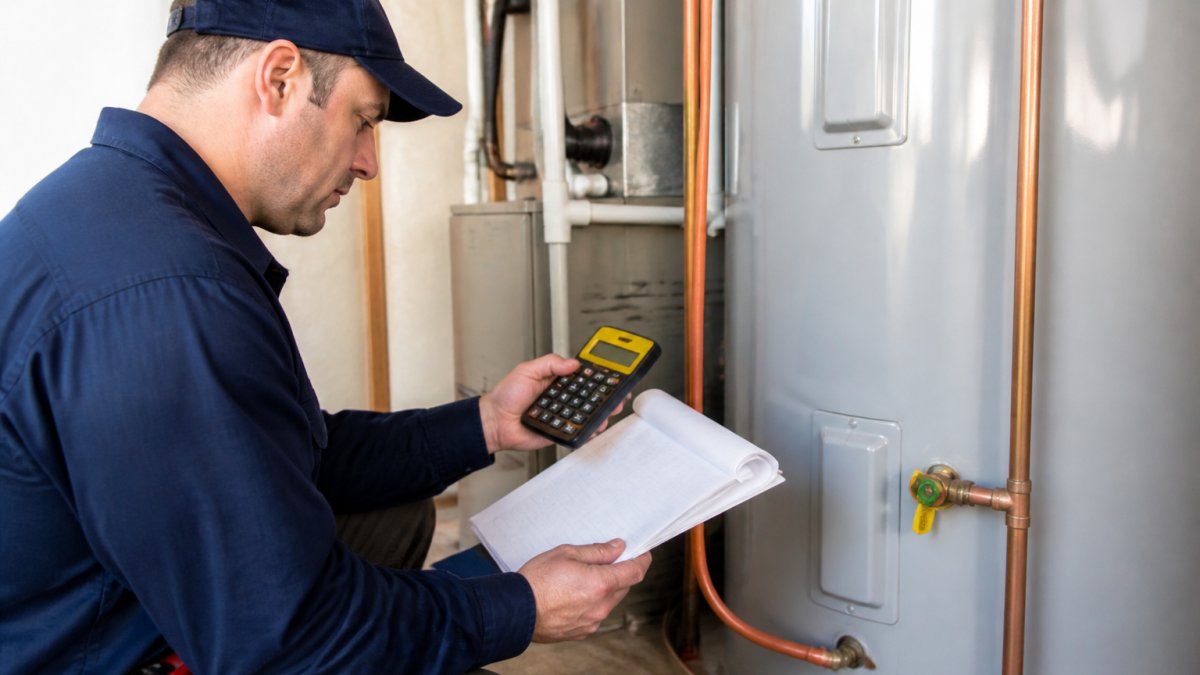
Learning how to calculate water heater energy efficiency starts with one honest number: how much hot water your household actually uses. That figure drives every calculation that follows. The same mistake shows up again and again: people estimate their usage from memory instead of measuring it.
Gather these before you start:
- Your utility bill (electricity in kWh, gas in therms)
- The Uniform Energy Factor (UEF) rating on your heater's yellow EnergyGuide label
- Your heater's tank size in gallons, or its flow rate if tankless
- The incoming water temperature in your area
- A thermometer and a measuring cup
Understanding Uniform Energy Factor for Water Heaters
Uniform Energy Factor (UEF) is a standardized rating that measures how much of the energy going into a water heater actually heats water, versus how much escapes as heat loss. It replaced the older Energy Factor rating and comes from a set testing procedure defined by the U.S. Department of Energy.
Higher UEF means less wasted energy. A gas storage tank typically lands in the 0.60 to 0.70 range, while a heat pump water heater can exceed 3.0 because it moves heat rather than creating it. Those numbers aren't directly comparable across fuel types, though, which trips up a lot of people.
UEF vs. Measured Operating Efficiency
UEF comes from a lab test under fixed conditions: a set draw pattern, a set incoming water temperature, a set room temperature. Your home rarely matches any of that.
Measured operating efficiency is what you get when you divide the energy that actually heated your water by the energy your heater actually consumed. It accounts for your real usage, your real ground water temperature, and your real standby losses. The gap between the two can be wide.
Step 1: Estimate Your Daily Hot-Water Demand
Daily hot-water demand is the total gallons of hot water your household draws in a day. Add up each fixture and appliance, then multiply by how often you use it.
A common approach is to assign a typical volume to each load:
| Fixture or Appliance | Typical Hot Water Per Use |
|---|---|
| Shower | 10-15 gallons |
| Bath | 20-30 gallons |
| Dishwasher cycle | 4-6 gallons |
| Clothes washer load | 15-25 gallons |
| Kitchen sink use | 1-2 gallons |
A family of four taking one shower each and running one dishwasher load lands around 50-70 gallons per day. Household size and peak usage matter more than the daily average, because your heater has to keep up during the busiest hour, not across 24.
Step 2: Calculate Energy Required to Heat Water
The energy required to heat water follows one formula. The weight of the water times the temperature rise times a constant gives you the Btu needed.
Here's the transparent version:
Btu = gallons × 8.34 × temperature rise
The 8.34 is the weight of one gallon of water in pounds. Temperature rise is your target hot-water temperature minus the incoming-water temperature.
For 60 gallons at a 70°F rise: 60 × 8.34 × 70 = 35,028 Btu per day. Convert to kilowatt-hours by dividing by 3,412, which gives about 10.3 kWh. For gas, divide Btu by 100,000 to get therms, which comes to about 0.35 therms.
Temperature Rise and Incoming-Water Temperature
Incoming-water temperature swings with the season. Ground water runs colder in winter and warmer in summer, so the same shower costs more energy in January than in July. In colder regions, incoming water can sit near 40°F in winter, pushing the temperature rise toward 80°F or more.
That seasonal shift is one reason a single efficiency figure never tells the whole story. If you want a defensible estimate, run the math twice: once with a winter incoming temperature and once with a summer one.
Using a Water Heater Energy Consumption Calculator
A water heater energy consumption calculator automates the formula above. You enter your daily gallons, your temperature rise, and your heater's UEF, and it returns daily energy use.
The catch is that most calculators assume a fixed incoming-water temperature. If you live somewhere with cold winters, that default can understate your real energy use. Check what assumptions the tool makes before you trust its output.
You can also skip the tool and do it by hand. Take your daily Btu from Step 2, divide by the UEF to get the energy input required, then convert to your billing unit. That manual path forces you to see every assumption, which is exactly what you want when the number matters.
Water Heater Operating Cost Calculation: Converting Energy to Dollars
Operating cost is your daily energy input multiplied by your utility rate, then multiplied by the number of days you're estimating for. The formula is simple; the inputs are where people go wrong. Here's the full chain, worked end to end.
Start with the useful energy from Step 2. For 60 gallons at a 70°F rise, that was 35,028 Btu per day, or about 10.3 kWh equivalent. Now divide by the heater's UEF to get the energy actually drawn from the utility:
Energy input = useful energy ÷ UEF
- Electric storage tank, UEF 0.92: 10.3 ÷ 0.92 ≈ 11.2 kWh per day
- Gas storage tank, UEF 0.65: 0.35 therms ÷ 0.65 ≈ 0.54 therms per day
- Heat pump water heater, UEF 3.0: 10.3 ÷ 3.0 ≈ 3.4 kWh per day
Now multiply by your rate. Use the actual rate from your bill, not a regional average, because the difference matters. If your electricity rate is $0.16 per kWh, the electric tank costs 11.2 × $0.16 ≈ $1.79 per day, or about $654 per year.
Those three numbers are the whole point of the calculation. A heat pump water heater can cut annual water-heating energy cost by more than half versus a standard electric tank at the same usage, but only if the unit sits in a space warm enough to run efficiently.
Work through it in order:
- Find daily energy input in kWh or therms (useful energy ÷ UEF)
- Look up your actual rate per unit from your bill, not the average
- Multiply daily energy by rate for a daily cost
- Multiply by 365 for an annual estimate
Run the same math for a higher-UEF unit and the difference shows you what an upgrade could save. Rates vary by utility and by season, so use your own bill. A U.S.
Water Heater Standby Heat Loss and How It Affects Efficiency
Water heater standby heat loss is the energy a storage tank loses to the surrounding air while no one is using hot water.
Here's the mechanism. A tank holds hot water at your setpoint, say 120°F, in a room that might be 65°F.
You can estimate the standby penalty with a simple ratio.
Standby loss grows with three things:
- A bigger temperature difference between tank and room
- Poor tank insulation or an older unit
- A cold location, like an unheated garage
That last one is why the same heater can perform very differently in two homes. A tank in a 65°F basement loses far less heat than the identical tank in a 40°F garage, because the temperature gap driving the loss is smaller.
Tankless units avoid most standby loss because they only heat water on demand. That's their main efficiency edge. But they trade standby loss for a higher recovery demand, so the comparison isn't as clean as the marketing suggests.
If your tank sits in a cold space, insulating the tank and the first few feet of pipe is one of the cheapest ways to cut standby loss. The payback is often quick.
How to Measure Energy Input at Home
Measuring energy input at home means reading your meter before and after a controlled test. It's the only way to get a real efficiency number instead of a rated one.
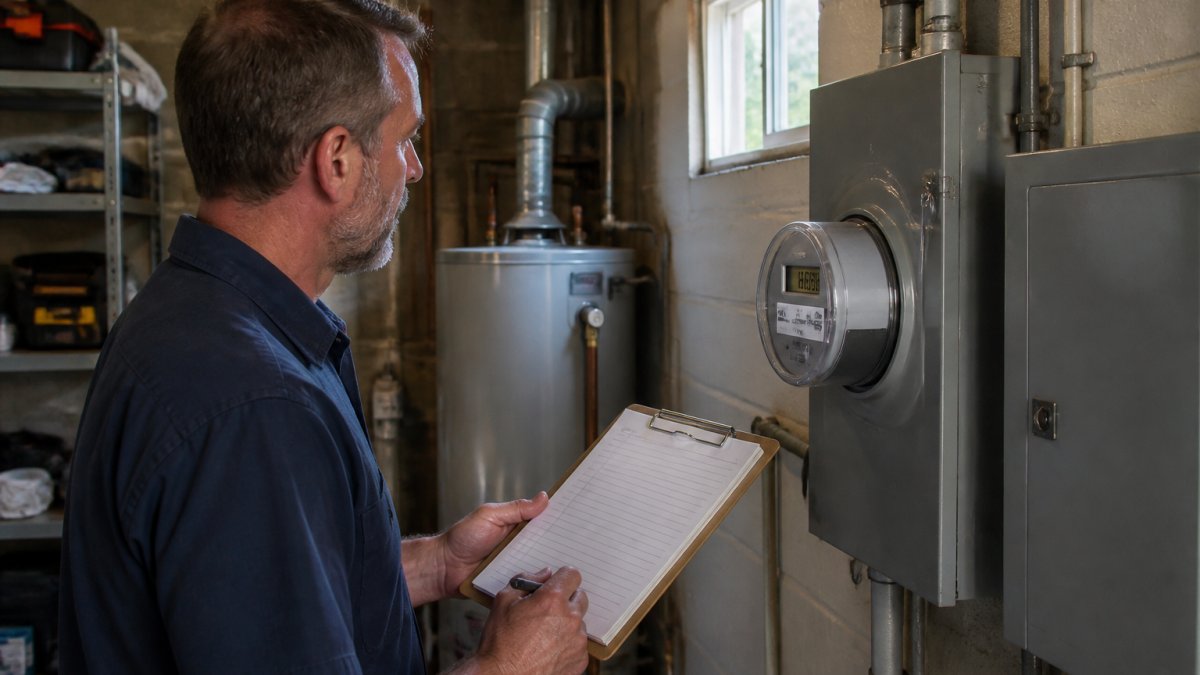
Here's how to do it:
- Shut off other major electric loads so they don't skew the reading
- Record your meter reading and the time
- Draw a known volume of hot water, say 20 gallons, and record the temperature rise
- Record the meter reading and time again once the tank recovers
- Divide the energy that heated the water by the energy the meter shows consumed
The result is your measured operating efficiency. Compare it to the UEF on the label. A big gap usually points to standby loss, a failing heating element, or sediment buildup in the tank.
A water heater that's silently wasting energy costs you every month, and the math above is how you catch it. If your measured efficiency comes in well below the rating, or you'd rather not climb around a utility room with a clipboard, Colby Plumbing Company LLC can help. We're family owned and operated, licensed and seasoned, and we've served the Denver metro area since 1996 with fast, affordable service and a 100% satisfaction guarantee. Contact us today to schedule a water heater inspection.
Frequently Asked Questions
How do I calculate the energy efficiency of a water heater?
Start with the Uniform Energy Factor (UEF) on the yellow EnergyGuide label. UEF represents the ratio of useful hot water energy delivered to the total energy consumed during a standardized test. To estimate real-world efficiency, divide the energy required to heat your daily hot water (based on gallons used and temperature rise) by the total energy your heater actually consumes. This gives you a practical efficiency percentage that accounts for standby loss and your specific usage patterns.
What is the formula for calculating heater efficiency?
The basic formula is: Efficiency = (Energy Output ÷ Energy Input) × 100. For a water heater, energy output equals gallons of hot water used per day × 8.34 lbs/gallon × temperature rise in °F. Energy input comes from your utility bill (therms of gas or kWh of electricity) converted to consistent units. For example, if heating your water theoretically requires 15,000 Btu but your gas bill shows 20,000 Btu consumed, your operating efficiency is 75%.
How can I estimate how much energy my water heater uses?
Check the EnergyGuide label for estimated annual operating cost and kWh or therms used. For a more precise estimate, track your daily hot-water usage in gallons, measure the temperature rise (setpoint minus incoming water temperature), and apply the formula: Btu required = gallons × 8.34 × temperature rise. Then divide by your heater's UEF to get actual energy consumed. A water heater energy consumption calculator can automate this if you prefer not to work through the math manually.
How do I compare the efficiency of tank and tankless water heaters?
Compare their UEF ratings directly. Tankless units typically achieve UEF of 0.90 to 0.99 because they heat water on demand with no standby loss. Storage tank heaters usually range from 0.60 to 0.70 due to continuous standby heat loss through the tank walls. However, tankless efficiency can drop if your household uses very little hot water, since the unit still cycles to maintain readiness. For high daily usage, tankless often wins on operating cost; for low usage, the gap narrows.