 how-to
What Documentation Do You Need for a Plumbing Leak Claim?
Last Updated: November 1, 2026
Quick Summary
To support a plumbing leak claim, you need dated photos and video of the damage before cleanup, a licensed plumber's written report stating the cause of loss, receipts for emergency repairs, and a water damage inventory listing each item with its age and value. You should also keep a dated log of every call and email with your insurer. Report the leak the same day you find it and photograph the failure point before repair.
- Shut off the main water supply first, then photograph the damage before cleaning anything.
- Call your insurer the same day you find the leak and record the claim number and adjuster's name.
- Ask the plumber to photograph the failure point before making the repair, since that evidence disappears once replaced.
- Never discard damaged property until the adjuster has seen it or approved disposal.
- Request an extension in writing before a proof-of-loss deadline passes if you cannot meet it.
Table of Contents
- What a Plumbing Leak Claim Actually Requires
- Your Plumbing Leak Insurance Claim Checklist
- Water Damage Claim Photos That Adjusters Accept
- Getting a Plumber Report for Your Insurance Claim
- Building a Water Damage Inventory Template
- Keeping Receipts, Reports, and a Claim Document Log
- The Claim Timeline From Discovery to Settlement
- Scheduling a Licensed Plumber Before You File
- Frequently Asked Questions
What a Plumbing Leak Claim Actually Requires
A plumbing leak claim lives or dies on paperwork. Your insurer needs proof of what happened, when, and what it damaged.
The adjuster was not standing in your kitchen when the pipe burst. They only know what you show them.
Homeowners who get paid typically have dated photos, a plumber's written findings, and a clean paper trail. Before gathering any of it, check whether homeowners insurance covers plumbing repairs so you know what your policy will and will not pay for.
Sudden and Accidental vs. Gradual Damage
Policies cover sudden and accidental damage. A pipe that bursts overnight is sudden. Water seeping behind a cabinet for months is gradual.
That distinction decides most claims. Gradual leaks usually fall under wear and tear or lack of maintenance, both standard exclusions.
One more thing: the failed pipe itself is often excluded, but the resulting damage to floors, drywall, and belongings usually is not.
Your Plumbing Leak Insurance Claim Checklist
Treat this as your plumbing leak insurance claim checklist. Work top to bottom and do not skip steps, even when the damage looks minor.
- Shut off the water and stop the leak
- Photograph and video the damage before cleanup
- Call your insurer and open the claim
The checklist matters because claims are won in the first 48 hours, not at settlement.
Immediate Steps to Stop the Leak and Prevent Further Damage
Shut off the main water supply first. Everything else can wait.
If you are unsure where the valve is, how to shut off main water supply walks through it step by step. Then:
- Open a low faucet to drain remaining pressure
- Move furniture and rugs away from wet areas
- Put towels down, but do not pull up soaked flooring
Insurers expect you to prevent further damage. They also expect you to leave the evidence in place until it is recorded.
When and How to Notify Your Insurer
Call your insurer the same day you find the leak. Most policies require prompt notice, and waiting weakens your claim.
What to say: the date and time you found the leak, where it is, and what is damaged. Keep it factual.
Write down the claim number, the adjuster's name, and the date of the call. That single note becomes the first entry in your claim log.
Water Damage Claim Photos That Adjusters Accept
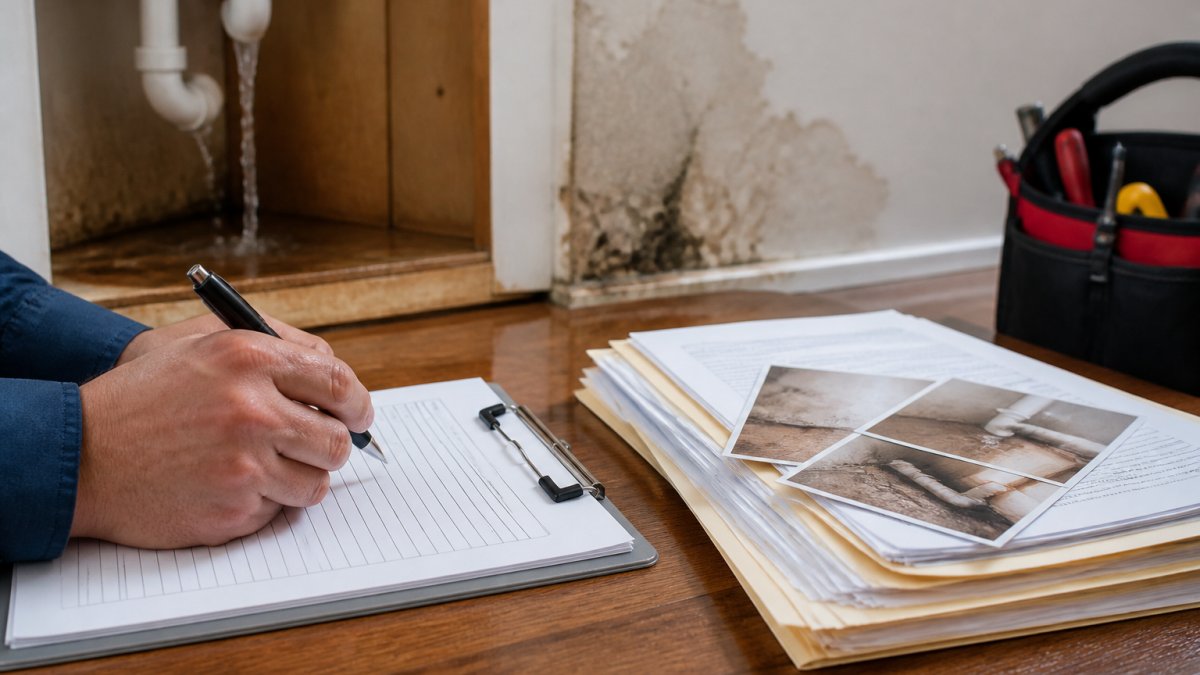
Good water damage claim photos show scale, location, and timing. A close-up of a wet spot proves nothing on its own.
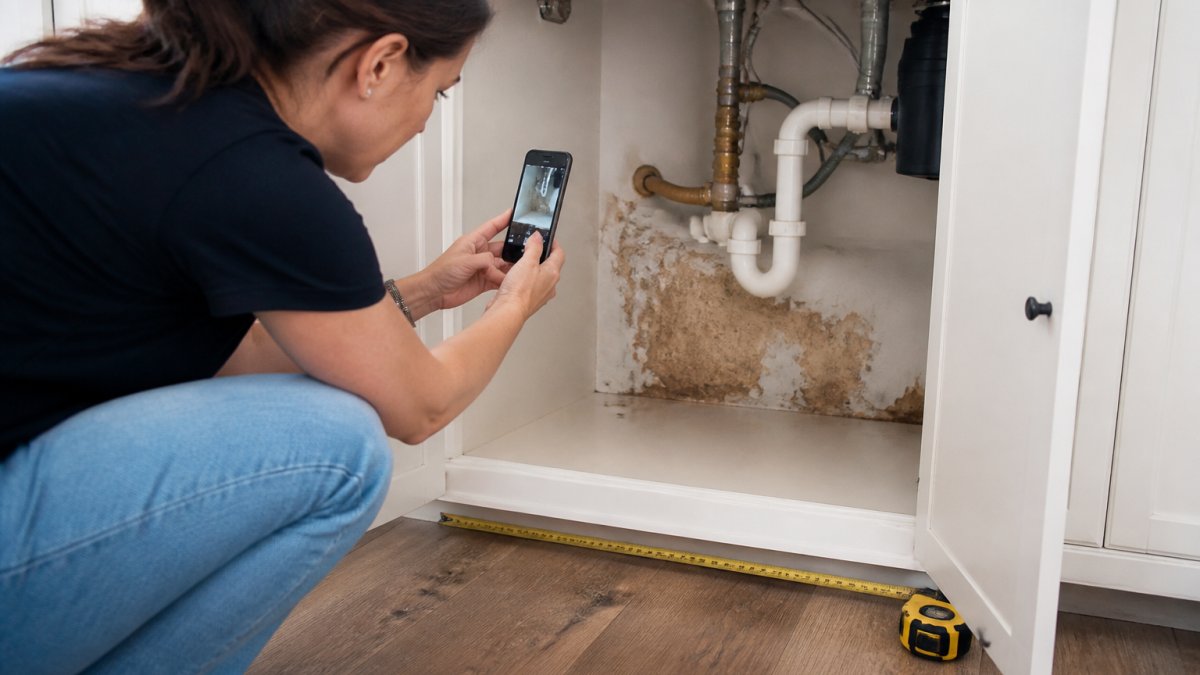
Shoot wide, then close.
Turn on location and time stamps in your phone camera settings. If your phone does not record them, note the date and time in the log.
Video helps too. Walk slowly through the damage and narrate what you see. Adjusters use video to understand layout and extent.
Documenting Hidden Moisture Before Mold Sets In
Mold can complicate a claim. Once mold sets in, insurers may ask whether the leak was reported promptly, and remediation costs can climb.
You cannot photograph moisture you cannot see, so hidden leaks need professional detection. How to detect hidden water leaks covers the methods, from meter tests to thermal checks.
Ask your plumber whether moisture readings can be recorded in the report, since meter numbers generally carry more weight than a description.
Getting a Plumber Report for Your Insurance Claim
A plumber report for an insurance claim should state the cause of loss in plain, specific terms and give the adjuster a reason to treat the event as sudden and accidental rather than gradual. "Failed supply line at the shutoff, sudden rupture" is what an adjuster needs.
Ask for a written report that includes:
- Date and time of inspection
- The specific failed component and its condition (for example, a split fitting, a corroded section, or a failed supply line)
- Whether the failure is consistent with a sudden event or with long-term seepage
Get the report before you file if you can. It shapes how the claim is opened and reduces back-and-forth later.
How the Report Establishes Sudden Versus Gradual Cause
The sudden-versus-gradual distinction decides most plumbing leak claims. Gradual leaks usually fall under wear-and-tear or maintenance exclusions. Your plumber's report is the strongest evidence you can put before an adjuster, but only if it addresses cause directly.
Ask the plumber to answer three questions in writing:
- What failed, and how? A split fitting from a pressure surge reads differently than a pinhole from years of corrosion. The mechanism matters.
- Is there evidence of long-term seepage? Staining patterns, mineral buildup, and softened framing can suggest a slow leak. If the plumber sees none, say so in the report.
- What is the repair scope? A scope tied to a single failed component supports a single-event theory. A scope that lists multiple deteriorated sections invites a maintenance argument.
Documenting Pre-Existing Conditions and Maintenance History
If the area had prior work or a known slow drip, disclose and document it. Adjusters can access permit records and prior claims, and an undisclosed pre-existing condition damages your credibility more than the condition itself.
Gather prior repair invoices, permit records from your local building department, and maintenance receipts. If the plumber concludes the failure is unrelated to prior work, ask them to state that in the report.
What the Report Should Not Say
Avoid reports that guess at cause or use vague language. "Looks like it has been leaking a while" in a plumber's report can be used to support a gradual-damage denial. If the plumber is unsure, ask them to describe what they observed rather than speculate. Observations support your file; speculation can undermine it.
Matching the Report to Your Other Evidence
The plumber report should line up with your dated photos, moisture readings, and repair invoice. If the report says the failure was sudden but your photos show long-term staining, the adjuster will notice. Review the report against your photo log before submitting, and resolve inconsistencies with the plumber while the job is fresh.
A licensed plumber's report can help establish cause, timing, and scope in one document. Treat it as evidence, not a receipt.
Building a Water Damage Inventory Template
A water damage inventory template is a simple table listing every damaged item, its age, its condition, and its replacement value. Insurers ask for this, and most homeowners hand over a vague list.
Use this format:
| Item | Room | Age | Condition Before | Replacement Value | Evidence |
|---|---|---|---|---|---|
| Area rug | Living room | 3 years | Good | $ | Photo, receipt if kept |
| Laptop | Home office | 2 years | Good | $ | Photo, serial number |
| Cabinet base | Kitchen | 10 years | Fair | $ | Photo, moisture reading |
Fill in real values from receipts or current retail prices. Photograph each item before you throw it out. Never discard damaged property until the adjuster has seen it or approved disposal.
Keeping Receipts, Reports, and a Claim Document Log
Every dollar you spend on emergency repairs needs a receipt. Every conversation needs a note. This is the boring part, and it is the part that wins settlements.
Your claim document log should record:
- Date and time of each call or email
- Who you spoke with
- What was said or agreed
How to document plumbing repair issues gives you a full method for building that paper trail. Keep receipts for cleanup, drying equipment, temporary repairs, and hotel stays if the home was uninhabitable.
The Claim Timeline From Discovery to Settlement
Most claims follow the same arc, but the deadlines inside that arc are set by your policy and your state's insurance rules, not by a generic calendar. The table below shows a typical sequence and what to document at each stage. Verify every deadline against your own policy declarations page and your state insurance department's consumer guide.
| Stage | What Typically Happens | What You Document | Deadline to Verify |
|---|---|---|---|
| Discovery | Leak found and stopped | Date/time photo, shutoff photo, first wet-spot photo | Prompt notice period in your policy (often stated as "immediately" or within a set number of days) |
| Notice | Claim opened with insurer | Claim number, adjuster name, call date/time, recorded statement copy | Notice deadline in policy; state prompt-notice rules |
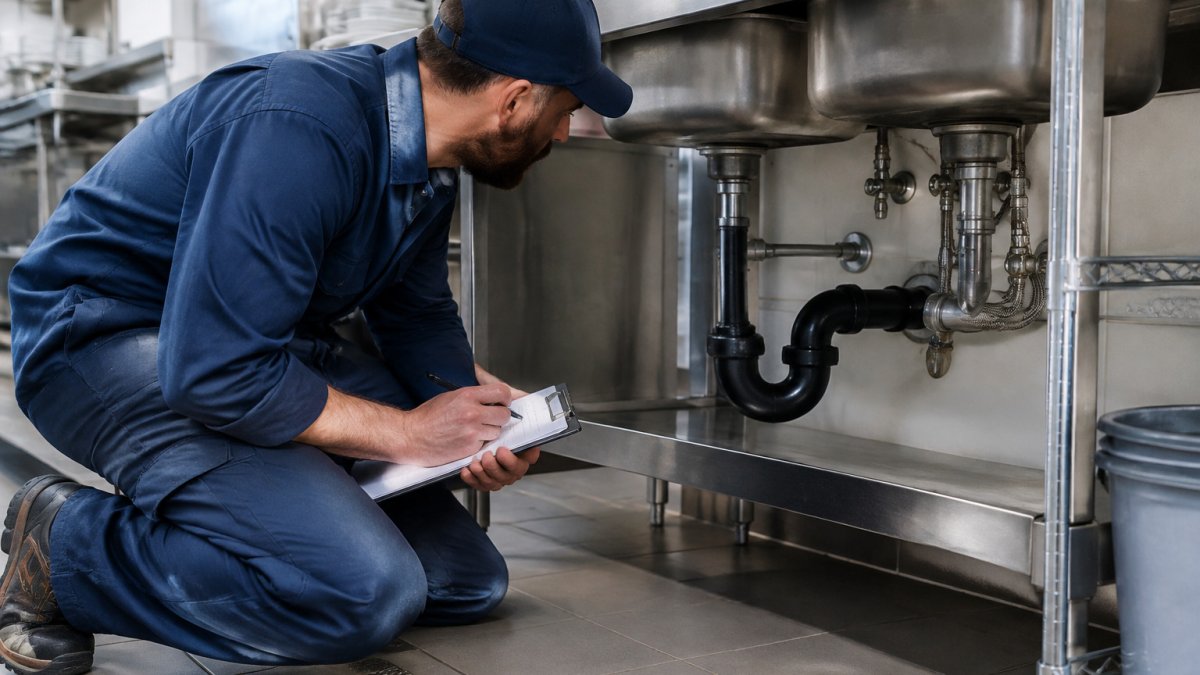
| Inspection | Plumber and/or adjuster visits | Plumber report, moisture readings, adjuster photos, sign-in sheet | Scheduling window the insurer gives you in writing |
| Scope and estimate | Contractor estimate compared to insurer scope | Line-item estimate, photos of each damaged component, moisture log | Any deadline to submit your own estimate |
| Proof of loss | Sworn statement and inventory submitted | Signed proof of loss, inventory table, receipts, prior photos | Proof-of-loss deadline stated in the claim letter (commonly a set number of days from request) |
| Settlement | Offer, negotiation, or denial | Offer letter, your written response, any appraisal or appeal filing | Appeal or appraisal deadline in policy and state rules |
How to Verify Your Actual Deadlines
Do not rely on a blog table for dates. Pull three documents and read them side by side:
- Your policy declarations page and the "Duties After Loss" section. This is where the notice, proof-of-loss, and cooperation requirements live. The wording controls.
- Your claim acknowledgment letter or email. Adjusters often state a proof-of-loss deadline and a date by which they expect your inventory. Put that date in your claim log the day you receive it.
- Your state insurance department's consumer publication. Rules on claim handling, prompt payment, and appeal rights vary by state. The department's website is the authoritative free source, and many publish a complaint and appeal process you can follow if a deadline is disputed.
What to Document at Each Stage
- Before mitigation: wide, mid, and close photos of every wet area; a video walkthrough with narration; the shutoff valve and the failed component; any moisture meter readings your plumber takes.
- During mitigation: receipts for drying equipment, extraction, and temporary repairs; photos of anything removed or discarded only after adjuster approval; a daily drying log if fans or dehumidifiers run for days.
- At inspection: the adjuster's name, arrival time, what they photographed, and any verbal statements about scope. Follow up with an email summarizing the visit.
The Hidden-Moisture Stage Competitors Skip
Visible damage is only part of the file. Hidden moisture behind cabinets, under flooring, and inside wall cavities is where mold claims begin and where insurers scrutinize promptness.
A stage-by-stage timeline is only useful if it is tied to your documents. Build the log first, then map each entry to the stage above so you can show the adjuster a clean sequence from discovery to settlement.
Scheduling a Licensed Plumber Before You File
Before you hire, vet the company. 10 questions to ask before hiring a plumber covers licensing, insurance, and written estimates.
WATCH OUT: Hiring an unlicensed handyman for the "cheap fix" can void your claim. Insurers can deny a claim when unpermitted or unqualified work contributed to the damage.
Colby Plumbing Company LLC is a family-owned and operated business serving the Denver metro area since 1996.
Frequently Asked Questions
Should I call a plumber before filing a water damage claim?
Yes. Stop the leak first, then document it. A licensed plumber can shut off the supply, make emergency repairs, and write a report identifying the cause of loss, such as a failed supply line or burst pipe. That report is the evidence your insurer uses to separate a covered sudden failure from gradual wear and tear. Keep the plumber's invoice and any photos taken before repairs began, since the failed part is often replaced during the fix.
How do I prove where a plumbing leak came from?
Photograph the failed component before it is removed, note the date and time you discovered the leak, and ask your plumber to state the cause in writing. Moisture readings from a plumber or mitigation contractor help show the leak's path through walls or flooring. Save the failed part if possible. Insurers look for a clear cause of loss, so a plumber report naming the specific failure carries more weight than a general description of water damage.
What should I include in a water damage inventory?
List each damaged item with its description, approximate age, purchase price, and replacement cost, then attach photos and receipts where you have them. Group items by room so the adjuster can match them to your photos. A water damage inventory template with columns for item, date acquired, cost, and condition keeps the list consistent. Do not throw away damaged belongings until the adjuster has inspected them or told you to dispose of them.
Does homeowners insurance cover damage from a plumbing leak?
Most policies cover sudden and accidental water damage, such as a burst pipe, along with the resulting damage to walls, floors, and belongings. Gradual leaks and long-term wear and tear are usually excluded, and the failed pipe itself is often not covered even when the water damage is. Coverage depends on your specific policy, so read the exclusions and call your insurer to confirm before you assume a plumbing leak claim will be paid.
A leak is stressful enough without a denied claim on top of it. The fix is simple: document everything, hire licensed help, and keep a clean file from hour one. Colby Plumbing Company LLC offers licensed plumbers, written reports for your insurer, and fast emergency response. Get started with Colby Plumbing Company LLC and turn a burst pipe into a claim that gets paid.